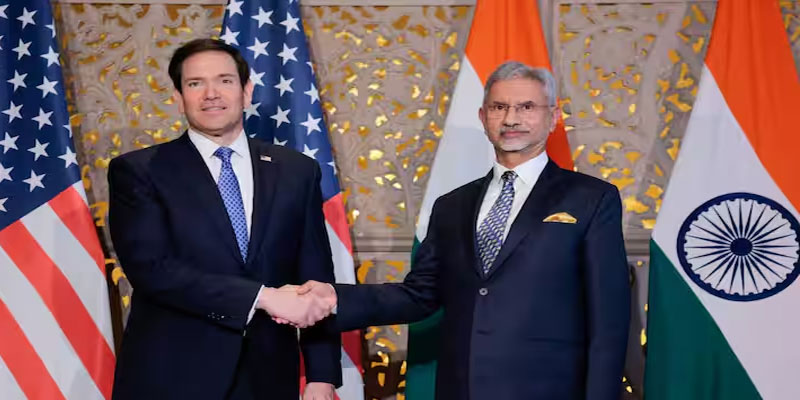
India’s refinery power could be its trump card against America as Washington reconsiders its approach towards New Delhi amid changing global energy dynamics. What began as a confrontation over tariffs and Russian crude purchases is increasingly turning into a negotiation driven by energy security, commercial interests and strategic cooperation. The October 20–22 visit of US Secretary of State Marco Rubio, particularly his visit to Mumbai and Reliance Industries’ Jamnagar refinery, underlines this changing equation. India’s massive refining infrastructure is emerging as an important source of geopolitical leverage.
Why India-US Relations Deteriorated in 2025
Relations soured after President Donald Trump launched his tariff offensive in April 2025 and increased pressure on India over its purchases of Russian crude oil. Washington sought to discourage countries from buying Russian energy, while New Delhi maintained that securing affordable and reliable energy supplies was essential to its national interests.
India resisted what it viewed as unilateral economic pressure, defending its strategic autonomy. Consequently, trade negotiations lost momentum, mutual trust weakened and expectations of an early breakthrough following Trump's January 2025 inauguration remained unfulfilled.
Why Washington Is Now Re-engaging
The changing global energy environment is encouraging Washington to reconsider India's importance. Conflict-related instability in West Asia has increased the significance of alternative oil supplies and dependable refining infrastructure.
India possesses precisely that capability. Reliance Industries' Jamnagar complex can process approximately 1.4 million barrels of crude daily, representing nearly 1.5% of global refining capacity. It is also among the world's major exporters of diesel.
Rubio's visit to Jamnagar highlighted Washington's interest in India's ability to process heavier Venezuelan crude, diversify supplies beyond the Middle East and potentially increase purchases from the United States and other Western Hemisphere producers.
Refining Capacity: India's Strategic Trump Card
India's advantage extends beyond being one of the world's largest oil consumers. Its ability to process difficult, discounted and geopolitically sensitive crude into valuable petroleum products gives it considerable influence over international energy markets.
Jamnagar's sophisticated refining technology makes Reliance a potential partner in managing Venezuelan crude supplies and stabilising global fuel markets. This creates a significant bargaining advantage for New Delhi.
Rubio described India as a "refining superpower", acknowledging that America could become a source of some of its energy inputs. The implication is important: Washington needs India's refining capacity, market access and cooperation on energy security, making a purely pressure-driven relationship less practical.
From Tariff Confrontation to Commercial Negotiations
Rubio indicated that an India-US trade agreement was "very close", with only a few unresolved issues. Discussions also covered defence cooperation, technology, energy security and market access.
President Trump's decision to waive sanctions on Indian purchases of Russian energy ahead of Rubio's visit further demonstrated Washington's tactical flexibility. However, the relief was described as temporary, leaving uncertainty over future energy transactions.
The shift suggests that commercial interests are increasingly influencing diplomatic calculations.
Strategic Reset Has Its Limits
Despite the improved engagement, this is not a complete reconciliation. Washington continues to favour reduced Indian dependence on Russian crude and greater purchases of American, Venezuelan and other Western Hemisphere supplies.
India, meanwhile, must evaluate every alternative based on affordability, reliability and long-term energy security. Its choices cannot be dictated solely by geopolitical pressure.
Turning Refinery Strength into Diplomatic Advantage
India's refining infrastructure has emerged as an important instrument of economic diplomacy. New Delhi can use its processing capacity and enormous energy market to negotiate better tariff terms, technology partnerships, diversified supplies and a sustainable trade agreement.
However, its greatest strength lies in maintaining flexibility rather than replacing one dependency with another. India's message to Washington is increasingly clear: cooperation is possible, but it must be based on mutual economic interests, not unilateral conditions. The real diplomatic victory would be an arrangement that strengthens India-US relations without compromising India's strategic independence.
(With agency inputs)