Driving Self-Reliance in Strategic Resources
In a decisive move to fortify India’s clean energy and technology sectors, the Union Cabinet has approved a ₹1,500-crore incentive scheme to promote large-scale recycling and extraction of critical minerals from e-waste, spent batteries, and industrial scrap. The policy, a core pillar of the National Critical Minerals Mission (NCMM) launched earlier this year, aims to ensure India’s long-term mineral security while curbing its reliance on imports.
The initiative — named the Critical Mineral Recycling Incentive Scheme (CMRIS) — will operate from FY 2025–26 to FY 2030–31, supporting industries engaged in recovering high-value materials such as lithium, cobalt, nickel, copper, rare earth elements (REEs), and platinum group metals (PGMs). These minerals are essential for electric vehicles (EVs), renewable power systems, semiconductors, and defense technologies.
How the Scheme Works
The government’s ₹1,500-crore corpus has been strategically divided to cover India’s three primary waste streams:
· ₹700 crore for lithium-ion battery recycling
· ₹650 crore for e-waste recycling
· ₹135 crore for industrial and catalytic scrap
Incentives will be performance-based, linked to investment size, extraction efficiency, and production output. The scheme categorises beneficiaries into two groups:
· Group A: Established recyclers (with revenues above ₹200 crore) can receive up to ₹50 crore each.
· Group B: Startups and smaller firms (revenues below ₹200 crore) are eligible for up to ₹25 crore each.
Notably, one-third of the total outlay is reserved for startups, ensuring that smaller innovators have a fair share in the recycling ecosystem. Crucially, incentives will apply only to final mineral recovery, not to partial or preliminary processes like black-mass production, promoting genuine value addition.
Why It Matters: Securing the Mineral Future
India’s rapid transition toward clean energy and digital infrastructure has made access to critical minerals a national priority. Materials such as lithium, nickel, and cobalt—vital for EV batteries and grid storage—are currently sourced mainly from China, Chile, and the Democratic Republic of Congo. Similarly, rare earths, indispensable in electronics and defense, are dominated by Chinese supply chains.
Experts project that India’s lithium demand will rise tenfold by 2035, highlighting the urgent need for alternative sources. Recycling, officials argue, offers a quicker, cleaner, and more sustainable route than waiting for new mines to become operational. According to the Ministry of Mines, recycling critical minerals emits nearly 80% less greenhouse gases compared to mining virgin ores — aligning with India’s Net Zero 2070 goals.
Economic and Environmental Impact
The scheme is expected to attract ₹8,000 crore in private investment and create over 25,000 green jobs. The government envisions establishing an annual recycling capacity of 270 kilotonnes, yielding around 40 kilotonnes of refined critical minerals every year.
Besides boosting industrial self-reliance, the initiative addresses India’s growing e-waste problem, which exceeds 3.2 million tonnes annually — of which only 20% is currently processed scientifically. By extracting reusable metals from discarded batteries and devices, the scheme turns waste into wealth while reducing environmental hazards.
These circular economy efforts directly support India’s Paris Climate Agreement commitments, lowering pressure on natural resources and reducing landfill waste.
A Pillar of India’s Global Minerals Strategy
The recycling incentive complements India’s wider mineral diplomacy efforts — including exploration partnerships with Australia, Argentina, and Namibia, and domestic surveys under the Minerals (Development and Regulation) Amendment Act, 2025. Together, these initiatives position India as an emerging hub for clean-tech mineral processing in Asia.
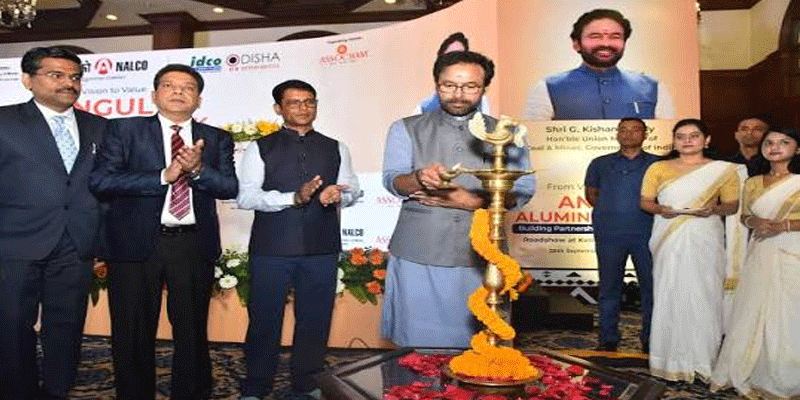
Industry leaders have praised the scheme’s foresight. As Union Mines Minister G. Kishan Reddy noted,
“This is more than a mining policy — it’s a roadmap for India’s technological sovereignty in the new energy era.”
Looking Ahead: From Waste to Wealth
Applications for the incentive scheme opened on October 2, 2025, and will remain active until April 1, 2026. Disbursement of funds will begin from FY 2026, based on verified project outcomes.
If executed effectively, the Critical Mineral Recycling Incentive Scheme could transform India’s resource ecosystem — bridging the gap between industrial demand and environmental responsibility. By recovering key materials from discarded products, India takes a strategic leap toward “Atmanirbhar Bharat”, ensuring that tomorrow’s green revolution is built not just on new resources, but on the intelligent reuse of old ones.
(With agency inputs)