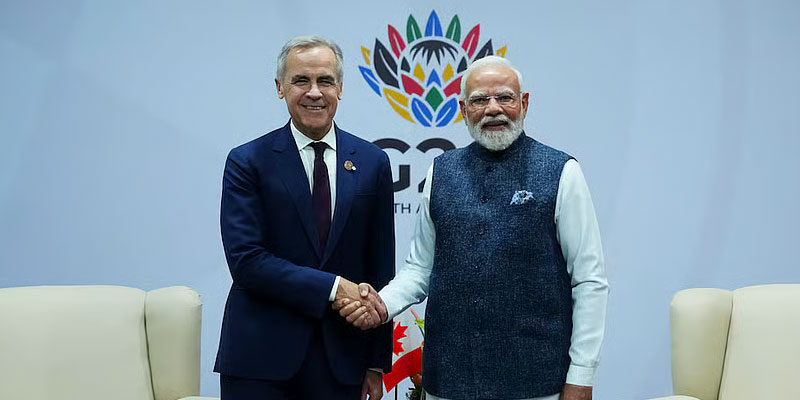
Prime Minister Narendra Modi on Monday met his Canadian counterpart Mark Carney as New Delhi and Ottawa attempt to reset ties after a turbulent diplomatic phase. Carney’s February 28–March 2 visit—the first by a Canadian prime minister since 2018—signals a thaw following tensions over Khalistani issues and allegations surrounding the killing of Hardeep Singh Nijjar. Both leaders framed the meeting as the beginning of a “new era of partnership,” pivoting decisively toward trade, energy security, and strategic supply chains amid global volatility.
A Diplomatic Reset Anchored in Economics
The outreach comes at a time of heightened geopolitical uncertainty, including the ongoing US–Israel–Iran conflict, which has rattled global energy markets. Carney described the engagement as “historic,” highlighting the 2 million-strong Indian diasporas in Canada and vibrant two-way travel and education flows. A renewed defence cooperation agreement—covering maritime operations, AI and quantum research, and joint exercises—signals mutual security interests spanning the Indo-Pacific and Arctic theatres.
At the core lies economic ambition. Negotiators finalized the Terms of Reference for a Comprehensive Economic Partnership Agreement (CEPA), targeting a signing by December 2026. The pact aims to slash tariffs—particularly sensitive dairy duties exceeding 50%—and boost access in agriculture, autos, and technology. Bilateral trade, currently around $10 billion, is projected to scale to $70 billion by 2030.
$5.5 Billion in Pacts: Energy and Minerals at the Center
Modi announced ten commercial agreements worth $5.5 billion, including a landmark $2.6 billion uranium supply deal with Canadian major Cameco. The 10-year contract (2027–2035) will supply 22 million pounds of uranium to fuel India’s 22 GW nuclear fleet, which is set to triple capacity by 2032. This reduces India’s reliance on Kazakhstan and Russia, which currently account for roughly 60% of its uranium imports.
Beyond nuclear energy, MoUs span LNG, hydrogen, solar collaboration, and Canada’s potential participation in the International Solar Alliance. HCL Technologies also confirmed expansion plans in Canada, increasing employment from 3,000 to 5,000 jobs.
Critical Minerals: A Strategic Diversification from China
The most transformative pillar of the reset lies in critical minerals. A new MoU framework targets lithium, nickel, cobalt, and rare earths through joint mining ventures in Saskatchewan and Quebec, alongside technology transfer and annual ministerial dialogues.
Canada—home to the world’s second-largest lithium reserves after Australia—offers India access to 5–10% of its potential lithium output, particularly from the Ring of Fire region. This is vital for India’s ambition of producing 30 million electric vehicles by 2030 and scaling its $7 billion Production Linked Incentive (PLI) battery program. Nickel supplies will bolster semiconductor and EV manufacturing.
Globally, the partnership could marginally dilute China’s dominance, which currently controls about 80% of lithium processing and 60% of lithium hydroxide output. Analysts estimate the India–Canada corridor could reduce China’s processing share by 2–5% over time. In uranium markets, Canada’s 13% share of global output, combined with the Cameco deal, may add 1–2% incremental supply stability amid a price environment exceeding $100 per pound.
Supply Chain Resilience in a Volatile World
The Carney–Modi initiatives align India’s “Atmanirbhar Bharat” strategy with Canada’s diversification push away from US dependence. By linking Canada’s mineral wealth to India’s manufacturing scale, the two democracies position themselves as a G7–G20 bridge counterbalancing China’s resource leverage.
The deals also hedge against disruptions elsewhere—whether Middle Eastern oil shocks or broader geopolitical fragmentation. However, execution will demand over $10 billion in sustained foreign direct investment and careful management of environmental and Indigenous concerns in Canada.
Strategic Convergence Beyond Diplomacy
The Modi–Carney reset is more than a diplomatic thaw—it is a calculated economic realignment with global consequences. By anchoring cooperation in uranium and critical minerals, India and Canada are constructing an alternative supply architecture at a time when resource security defines geopolitical power. If successfully implemented, the partnership could reshape EV, nuclear, and clean energy supply chains, modestly rebalance China’s dominance, and reinforce a rules-based economic corridor between two major democracies. The true test now lies not in announcements, but in delivery.
(With agency inputs)