Why the India–EU Agreement Is Unprecedented
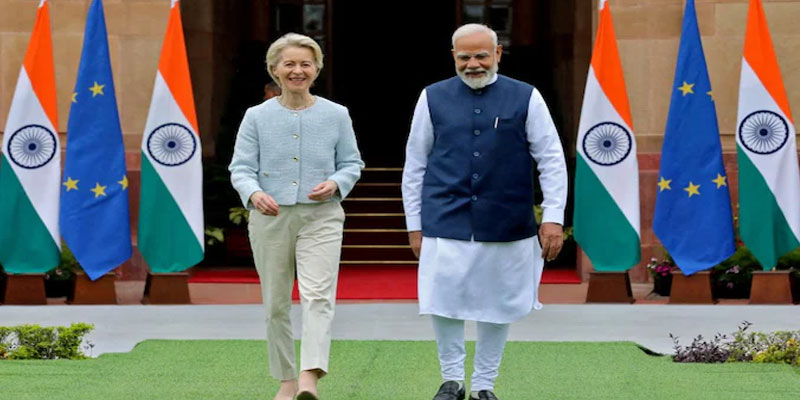
The proposed India–European Union Free Trade Agreement has earned the description “mother of all deals” because of its sheer economic and strategic scale. It aims to bind together two of the world’s largest economic blocs—nearly two billion people accounting for roughly a quarter of global GDP—at a time when global trade is being reshaped by geopolitical shocks, climate imperatives, and supply chain disruptions. More than a conventional tariff-cutting exercise, the pact is designed as a comprehensive framework covering goods, services, investments, digital trade, sustainability, and strategic cooperation, positioning it as one of the most consequential trade agreements of the decade.
India–EU Trade Relations: A Brief Overview
India and the EU share a long-standing commercial relationship. The EU is India’s largest trading partner and its biggest source of foreign direct investment, while India represents one of the EU’s fastest-growing major markets. Bilateral goods trade has crossed €120 billion annually, complemented by a strong services exchange driven largely by information technology, business services, and engineering. After negotiations first began in 2007 and stalled for over a decade, talks were relaunched in 2022, reflecting renewed political will on both sides amid changing global economic realities.
Anatomy of the Pact: Scope and Strategic Drivers
The agreement spans 24 chapters, with most already concluded, addressing market access, regulatory cooperation, standards, government procurement, and sustainable development. For the EU, the pact aligns with its strategy to reduce excessive reliance on China and secure trusted partners for critical inputs such as pharmaceuticals, clean technologies, and minerals. For India, it fits into a broader push to integrate more deeply into global value chains, leverage production-linked incentive schemes, and attract advanced manufacturing and green investments from Europe.
Impact on Global Supply Chains and Resilience Strategies
One of the most significant implications of the India–EU FTA lies in how it could reshape global supply chains. By lowering tariffs and harmonising standards, the pact encourages “friendshoring”—diversifying production away from concentrated geographies toward reliable partners. Indian manufacturing capacity in pharmaceuticals, electronics, textiles, and automotive components can integrate more tightly with European value chains, while EU firms gain a stable alternative base amid disruptions such as pandemics, conflicts, or shipping crises.
The agreement also embeds resilience mechanisms. Cooperation on standards, digital trade, and mutual recognition reduces non-tariff barriers that often choke supply flows. Joint approaches to sustainability, including alignment with the EU’s carbon border measures, support a gradual transition to low-carbon production rather than abrupt trade shocks. Enhanced mobility for skilled professionals strengthens digital and services resilience, reducing overdependence on any single market.
Challenges and Strategic Trade-offs
Despite progress, sensitive issues remain, including agriculture, dairy access, labour and environmental standards, and public procurement. Domestic political pressures on both sides could slow ratification, which requires approval from EU institutions and member states as well as India’s parliament. Small and medium enterprises may face adjustment costs, particularly related to climate compliance, even as long-term gains remain substantial.
A Deal That Redefines Trade Geometry
If concluded, the India–EU FTA would go beyond boosting trade volumes; it would recalibrate the geography of global commerce. By linking Europe’s technological depth and sustainability ambitions with India’s scale, demographics, and manufacturing push, the pact strengthens supply chain resilience in an era of fragmentation. Its success would signal a shift toward strategic, values-based economic partnerships—making the “mother of all deals” a cornerstone of the emerging global trade order.
(With agency inputs)