Industrial Output and Exports Scale New Highs
India’s economy has received a significant boost from two major indicators that underscore the country's strengthening economic fundamentals. India’s industrial output rose 7.3% in June 2026, up from 5.1% in May, marking the fastest pace of growth since July 2024 and the highest level in nearly two years. Manufacturing, the backbone of the industrial sector, expanded 7.8% year-on-year compared to 5.2% in May, reflecting robust domestic production.
Complementing this domestic momentum, India’s exports touched an all-time high of $863.10 billion in FY 2025-26, with merchandise exports reaching $441.80 billion and services exports climbing to $421.30 billion. The government's Free Trade Agreements (FTAs) with the UAE, the UK and Australia emerged as key drivers behind this remarkable export performance, opening new markets and boosting India's global competitiveness.
Industrial Recovery Becomes Broad-Based
The latest Index of Industrial Production (IIP) data indicates that India's industrial expansion is no longer limited to a handful of sectors. Manufacturing has led the surge, while electricity generation and capital goods production have also recorded healthy growth, suggesting that industrial activity is becoming more broad-based and sustainable.
This is particularly significant because higher capital goods production often reflects fresh investments in factories, machinery and infrastructure, indicating confidence in future demand rather than merely responding to current consumption. Increased electricity output further supports the view that industrial activity is expanding across sectors.
The broad-based nature of this recovery makes it more resilient and reduces the risk of growth being concentrated in only a few industries.
Policy Reforms Strengthening Manufacturing
India's manufacturing momentum has been reinforced by a combination of structural reforms and public investment. Large-scale infrastructure spending, Production-Linked Incentive (PLI) schemes, improved logistics, and a steady rise in urban consumption have all contributed to stronger industrial activity.
At the same time, improving rural demand has widened the consumption base, enabling industries to expand production. These developments suggest that India's supply side is responding positively to policy interventions, laying the foundation for sustained medium-term growth rather than a temporary cyclical rebound.
Exports Reflect India's Rising Global Competitiveness
India's record export performance demonstrates that its growth story is increasingly extending beyond domestic markets. The near-equal contribution of merchandise and services exports highlights the country's balanced strengths in both manufacturing and knowledge-based industries.
Engineering goods, electronics, automobiles and chemicals have benefited significantly from expanded market access under FTAs. Simultaneously, India's globally competitive IT services, fintech, business consulting and professional services continue to strengthen the services export basket.
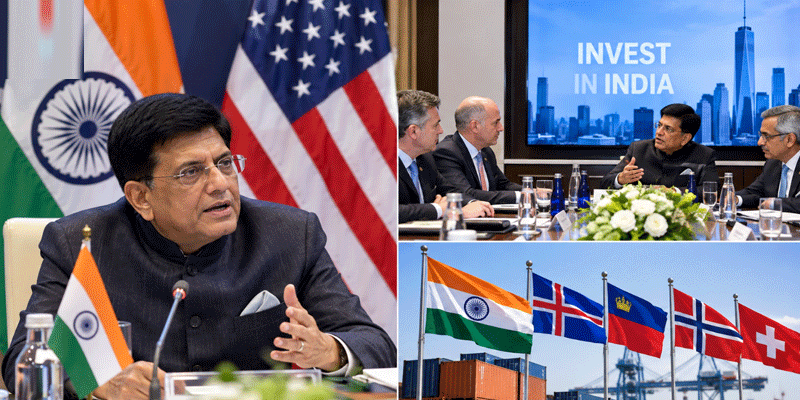
The trade agreements with the UAE, the UK and Australia, along with partnerships involving countries under the European Free Trade Association (EFTA), have reduced tariff barriers, diversified export destinations and strengthened India's integration into global supply chains.
Twin Engines Driving Sustainable Economic Expansion
The simultaneous rise in industrial production and exports presents a powerful economic narrative. Strong domestic manufacturing is creating greater production capacity, while record exports are ensuring that this capacity finds expanding international markets.
This balanced model reduces India's dependence on any single growth driver. Instead of relying solely on domestic consumption or external demand, the economy is increasingly benefiting from the synergy between both.
Higher industrial activity also supports employment generation, increased investments and stronger corporate earnings, while rising exports contribute to foreign exchange earnings and greater resilience against global economic uncertainties.
Building a More Resilient Growth Model
India's latest industrial and export data signal more than short-term economic acceleration—they reflect the emergence of a stronger and more diversified growth model. Robust manufacturing, expanding infrastructure, proactive trade diplomacy and successful Free Trade Agreements are collectively transforming India's economic landscape.
If this momentum is sustained through continued reforms, infrastructure investments, manufacturing incentives and deeper global trade integration, India will be better positioned to achieve higher long-term growth, create quality employment, enhance its manufacturing capabilities and strengthen its position as one of the world's leading economic powers. The convergence of strong domestic production and record external trade demonstrates that India's twin engines of growth are now working in tandem, providing a solid foundation for resilient and inclusive economic expansion.
(With agency inputs)