Odisha’s Free Education Push: From KG to PG and Expanded Food Security marks a significant expansion of the state’s welfare approach. By removing financial barriers across the education system and increasing monthly rice support for vulnerable households, the government is seeking to address two fundamental challenges simultaneously—access to education and household food security.
A Broader Welfare Vision
The initiatives build on Odisha’s existing welfare architecture, including free textbooks up to Class VIII and scholarships for SC/ST students. Since taking office in 2024, Chief Minister Mohan Charan Majhi has placed education and employment among key governance priorities. The government has also announced plans to recruit 45,000 teachers and establish 2,200 model primary schools under the Godabarish Mishra Adarsha Prathamika Vidyalaya scheme.
These measures are being pursued alongside wider social-sector programmes, including the Gopabandhu Jan Arogya Yojana and expanding skill-development initiatives aimed at improving access to opportunities.
KG-to-PG Education Without Fee Barriers
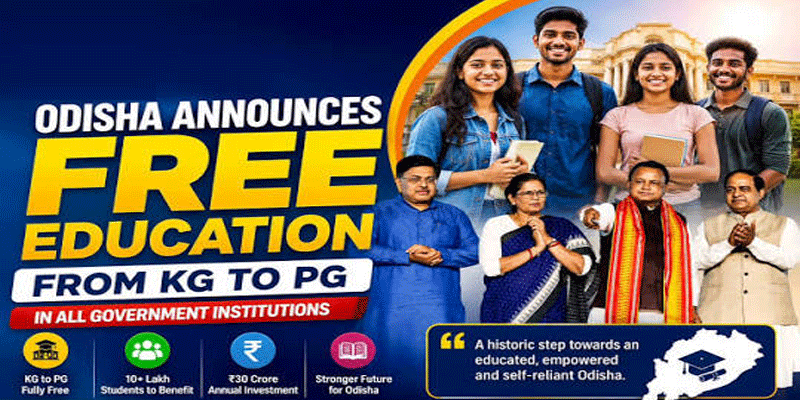
The major education decision for the 2026–27 academic session is the KG-to-PG free education initiative. Under the scheme, eligible students studying in government and government-aided institutions will receive exemptions from admission, tuition and other applicable fees.
Students will not be required to deposit fees at admission or during the first six months of the academic year, potentially easing the immediate financial pressure on families. The Higher Education Department has already released ₹9.56 crore as the first instalment under the ‘Gyanodaya’, also known as Shikshya Ru Samruddhi, scheme for Phase-1 undergraduate admissions.
The benefit extends across educational levels, from primary schooling to universities, with lakhs of students expected to gain from the initiative. However, a 75% attendance requirement has been incorporated to ensure that financial assistance is linked to regular participation in education.
Rice Entitlement Doubled Under Annapurna Scheme
The welfare expansion goes beyond classrooms. Under the Mukhyamantri Annapurna Yojana, eligible beneficiaries covered by the National Food Security Act and State Food Security Scheme will receive an additional 5 kg of rice per person every month.
This effectively raises the monthly entitlement from 5 kg to 10 kg per person. The programme is expected to cover around 3.28 crore beneficiaries, representing nearly 80% of Odisha’s population. The enhanced entitlement is intended to strengthen household food security while providing additional support to economically vulnerable families.
Implementation Will Determine Long-Term Impact
The combined approach carries important social and economic implications. Free education can reduce the cost burden on families, encourage continued enrolment and potentially improve retention and reduce dropouts. Greater food support, meanwhile, can provide households with a stronger basic nutritional safety net.
Yet the scale of the promise also creates implementation challenges. Private aided institutions have raised concerns about financial pressure arising from fee waivers, making timely and transparent reimbursement mechanisms important. The government will also need to safeguard educational quality, enforce attendance requirements effectively and maintain fiscal sustainability as coverage expands.
Welfare Must Translate into Opportunity
Odisha’s twin initiatives represent more than expanded subsidies. Together, they attempt to create conditions in which children can remain in education while families receive stronger protection against food insecurity. Their ultimate success, however, will depend not merely on the size of the benefits, but on efficient implementation, institutional support and measurable improvements in enrolment, attendance, learning and household security.
(With agency inputs)