India Boosts Energy Security with Diversified Oil Sources
India’s crude oil sourcing strategy underwent a significant shift in June 2026 as imports of Russian crude surged by 39%, reaching an estimated 2.25–2.66 million barrels per day (bpd), the highest monthly level ever recorded. At the same time, imports from the United States fell sharply to just 91,000 bpd from 252,000 bpd in May, highlighting New Delhi’s increasingly pragmatic and economics-driven approach to energy procurement. The trend underscores India’s focus on securing affordable and reliable supplies amid persistent geopolitical uncertainty and disruptions in key global energy corridors.
Energy Dependence Shapes India’s Strategy
India remains one of the world’s most energy-import dependent economies. The country imports nearly 88% of its crude oil requirements, about half of its natural gas demand, and roughly 65% of its LPG consumption. Historically, Gulf nations have supplied a substantial share of these needs, making India particularly vulnerable to geopolitical tensions and supply disruptions in West Asia.
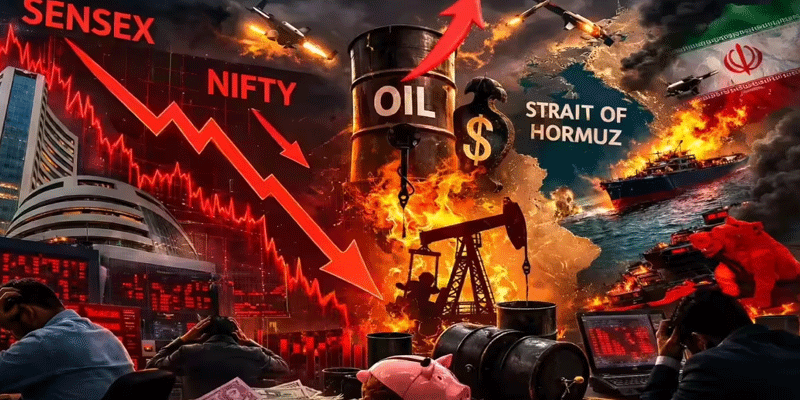
Recent instability around the Strait of Hormuz reinforced the urgency of reducing concentration risks. Before the disruption, nearly 45% of India’s crude imports, half of its LNG imports, and almost 90% of LPG shipments transited through the strategically vital waterway.
Russian Oil Remains the Preferred Choice
Russia has retained its position as India’s largest crude supplier primarily because of its pricing advantage. According to Kpler data, Russian shipments averaged around 2.66 million bpd between June 1 and June 19, up from 1.91 million bpd in May. Competitive discounts, favorable payment mechanisms, and the suitability of Russian grades for Indian refinery configurations have made these barrels particularly attractive.
Even with discussions surrounding a potential return of Iranian crude to global markets, analysts expect Russian supplies to remain central to India’s import basket because procurement decisions continue to be guided by economics rather than geopolitics.
Diversification Beyond Russia
While Russia dominates, India has simultaneously broadened its supplier base. The UAE emerged as the second-largest supplier in June with around 636,000 bpd, while Saudi Arabia supplied approximately 384,000 bpd. Venezuela also strengthened its position, becoming India’s fourth-largest supplier at nearly 209,000 bpd. These purchases have helped Indian refiners hedge against disruptions linked to Hormuz and reduce excessive dependence on any single region.
This diversification strategy has expanded India’s crude sourcing network from just over 20 countries to 41 nations, significantly improving supply resilience.
Hormuz Recovery but Risks Persist
Shipping activity through the Strait of Hormuz has gradually recovered following a ceasefire agreement between the United States and Iran. However, lingering accusations of ceasefire violations and broader regional tensions continue to cast uncertainty over long-term stability. Consequently, Indian refiners remain cautious and continue to prioritize diversified sourcing strategies.
Energy Sovereignty Through Flexibility
India’s June 2026 import pattern reflects a maturing energy security doctrine centered on diversification, affordability, and strategic flexibility. Record Russian imports, growing purchases from the UAE and Venezuela, and reduced dependence on vulnerable transit routes demonstrate a deliberate effort to safeguard the economy against geopolitical shocks. With crude prices expected to remain elevated in the $70–$80 per barrel range through 2026, India is increasingly prioritizing energy sovereignty through a balanced mix of suppliers, expanded reserves, and access to competitively priced, non-sanctioned crude.
(With agency inputs)