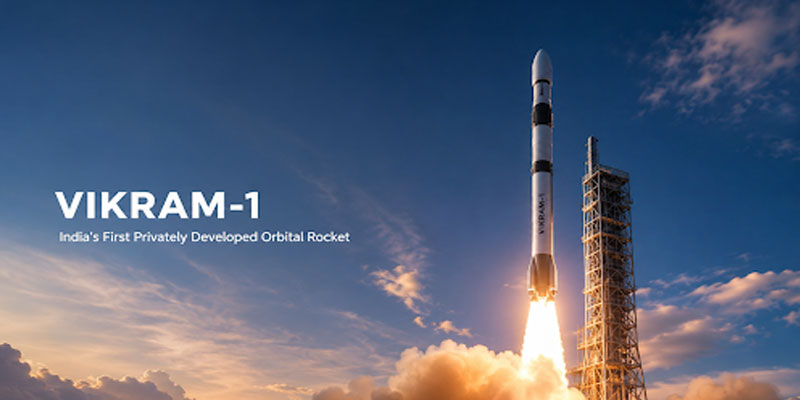
India has entered a new chapter in its space journey with the successful launch of Vikram-1, the nation's first privately built orbital launch vehicle, developed by Hyderabad-based Skyroot Aerospace. Lifting off from the Satish Dhawan Space Centre, Sriharikota, under Mission Aagaman, the rocket successfully deployed multiple payloads into a 450-km Low Earth Orbit (LEO). The milestone makes Skyroot Aerospace the first Indian private company to place satellites into orbit from Indian soil, underscoring the country's growing strength in commercial space technology.
Standing nearly 22 metres tall, Vikram-1 is capable of carrying payloads of up to 350 kilograms to Low Earth Orbit. The launch vehicle integrates several indigenous innovations, including 3D-printed rocket engines, advanced solid propulsion systems, and a precision orbital adjustment module. The mission successfully demonstrated critical technologies covering propulsion, guidance, navigation, telemetry, and flight control, establishing a strong foundation for future commercial launch services.
The achievement reflects the success of India's 2020 space-sector reforms, which opened the country's space ecosystem to private enterprises. Since then, startups such as Skyroot Aerospace have transformed India's NewSpace landscape by developing indigenous launch systems and attracting global investors. These reforms support India's ambition to expand its space economy from nearly $8 billion today to around $44 billion by 2033, significantly increasing its share in the global commercial launch market.
The Vikram-1 mission also carried customer payloads and technology demonstration satellites, highlighting India's growing capability to provide affordable and reliable launch solutions for domestic and international customers. Building on the successful Vikram-S suborbital mission in 2022, Skyroot has demonstrated a rapid transition from technology validation to operational orbital launch capability.
The successful launch of Vikram-1 marks a defining moment for India's commercial space ecosystem. While ISRO has established India as a respected space power, Vikram-1 demonstrates that private enterprises are now ready to become major contributors to the nation's space ambitions. This transition mirrors the evolution witnessed in countries like the United States, where private companies have become integral to national and commercial space missions.
Equally significant is the collaborative model emerging between ISRO and private industry. By providing policy support, infrastructure, technical expertise, and regulatory frameworks, ISRO has enabled startups to innovate without duplicating national investments. This partnership is expected to accelerate satellite launches for communications, Earth observation, defense, navigation, and scientific research while creating a vibrant domestic aerospace manufacturing ecosystem.
As the global demand for small satellite launches continues to surge, India is well positioned to become a preferred launch destination due to its engineering excellence, cost competitiveness, and rapidly maturing private space sector. Vikram-1 is therefore more than a successful rocket launch—it represents India's emergence as a global NewSpace leader, capable of driving innovation, attracting international business, strengthening strategic capabilities, and creating a sustainable commercial space economy for the decades ahead.