A Political Clash Moves into Constitutional Process
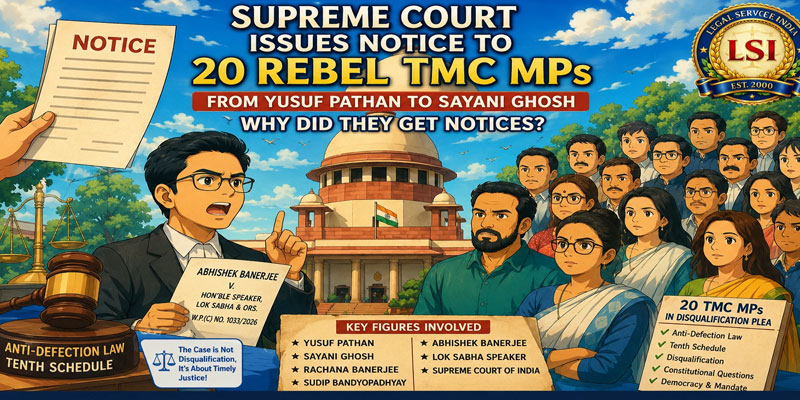
The TMC defection dispute has entered a crucial procedural phase after Lok Sabha Speaker Om Birla issued seven-day notices to 20 rebel Trinamool Congress MPs. The move takes the confrontation beyond political allegations and into the formal machinery of the anti-defection law. Yet, the notices do not establish that the MPs have defected. The Speaker must examine the allegations, the MPs’ responses and whether any constitutional protection applies.
How the Dispute Reached the Speaker
On June 19, TMC general secretary and Lok Sabha leader Abhishek Banerjee submitted 20 petitions seeking disqualification of the MPs. The party alleges that members elected on the TMC symbol broke away, merged with the Nationalist Citizens Party of India (NCPI) and extended support to the NDA.
When the matter remained unresolved, Banerjee approached the Supreme Court under Article 32, arguing that the Speaker’s inaction warranted judicial intervention. A three-judge Bench headed by Chief Justice Surya Kant subsequently issued notice to the 20 MPs and sought an expeditious process.
The Lok Sabha Secretariat has now sought their comments within seven days. But the distinction is important: issuing notices begins adjudication; it does not conclude it.
What the Tenth Schedule Requires
The constitutional test rests primarily on Paragraph 2 of the Tenth Schedule. A legislator can face disqualification for voluntarily giving up membership of the political party on whose ticket the person was elected. Importantly, formal resignation is not always necessary; conduct can demonstrate that a member has effectively abandoned the party.
However, political disagreement or support for another alliance does not automatically establish defection. The TMC will have to substantiate its allegations, while the MPs can challenge the evidence, deny abandoning the party or raise procedural and legal objections.
The potentially decisive issue is merger protection under Paragraph 4. Members can avoid disqualification when the original political party merges with another party and at least two-thirds of the legislature party agrees to that merger. The Speaker will therefore have to determine whether the alleged move to NCPI satisfies the constitutional threshold and genuinely constitutes a merger rather than individual defection.
Why The Timeline Matters
The Speaker’s authority under the Tenth Schedule is substantial but not beyond judicial review. The Supreme Court has recognised that Speakers exercising anti-defection jurisdiction perform an adjudicatory function. In Keisham Meghachandra Singh, the Court indicated that, barring exceptional circumstances, three months should ordinarily be treated as the outer limit for deciding disqualification petitions.
Since the TMC petitions were filed only around two months ago, it would be premature to conclude that the present process is legally delayed. But prolonged uncertainty carries political consequences. The MPs’ continued participation affects parliamentary numbers, committee functioning and potentially the balance of political power.
A Test of Law, Fairness and Parliamentary Trust
The dispute exposes a deeper structural problem in India’s anti-defection framework: politically consequential questions are entrusted to elected presiding officers, whose decisions can influence the very balance of legislative power.
The immediate test is whether the 20 MPs qualify for disqualification or merger protection. The larger test is whether the Speaker can deliver a reasoned, evidence-based and time-bound decision that withstands judicial scrutiny.
Ultimately, the credibility of the anti-defection law depends not merely on how quickly rebels are punished or protected, but on whether constitutional procedure rises above political convenience. Parliamentary democracy demands that defection disputes be settled by law, evidence and fairness—not by the strength of competing political claims.
(With agency inputs)