A Sudden Blow to Global Talent
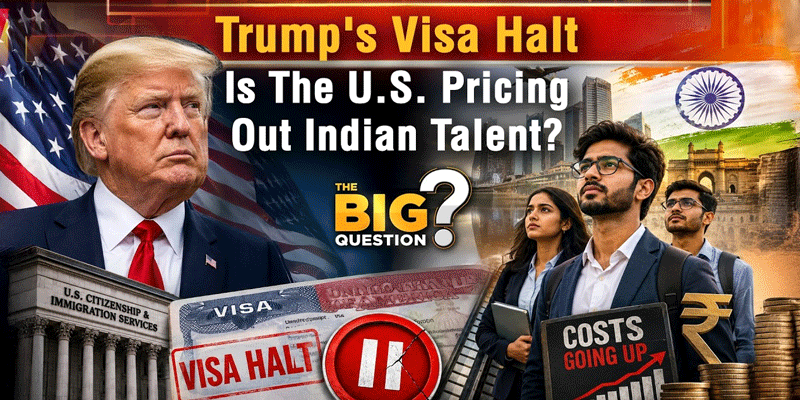
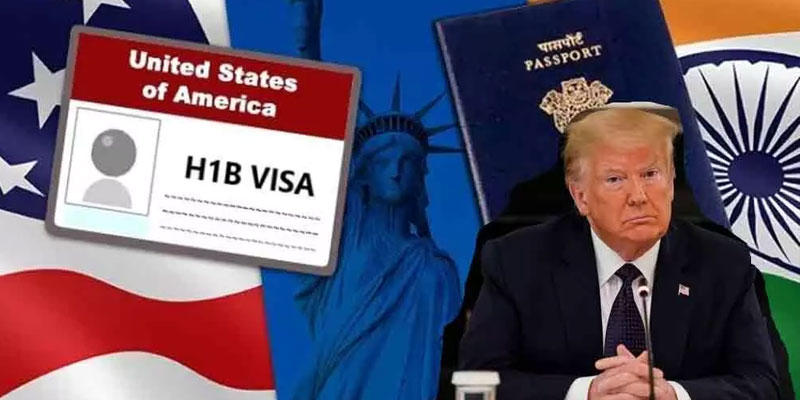
In a dramatic move that has sent shockwaves through the technology and business worlds, US President Donald Trump signed an executive order imposing an annual $100,000 fee on H-1B visa applications. Effective September 21, the policy will remain in place for at least 12 months, but may be extended further. Long regarded as the lifeline of Silicon Valley’s access to international talent, the H-1B program has now been burdened with a cost barrier that threatens to reshape global talent flows.
The decision, framed as a measure to protect American workers, has drawn swift criticism from corporate leaders and policy experts. Among the strongest reactions came from India’s former G20 Sherpa Amitabh Kant, who argued that this policy would suffocate US innovation while accelerating India’s growth story.
Kant’s Warning: “America’s Loss, India’s Gain”
Taking to social media, Kant declared that the decision could backfire on Washington: “Trump’s $100,000 annual fee on H-1B visas will choke US innovation and turbocharge India’s. By slamming the door on global talent, America pushes the next wave of labs, patents, innovation, and startups to Bangalore, Hyderabad, Pune, and Gurgaon.”
He suggested that Indian engineers, scientists, and innovators—who have long looked to the US for opportunities—would increasingly contribute to India’s domestic ambitions such as Viksit Bharat, transforming the country into a hub of global innovation.
Why the H-1B Program Matters
The H-1B visa is a cornerstone of America’s tech economy, granting 65,000 visas annually to foreign workers in specialized roles, plus 20,000 more for advanced degree holders. Indians account for nearly 70 percent of all recipients, meaning over 200,000 professionals could be impacted by the sudden fee hike.
The reliance is immense: Amazon secured over 10,000 H-1Bs in early 2025 alone, while Microsoft and Meta each received more than 5,000 approvals. Indian IT service giants like Infosys, TCS, Wipro, and HCL also depend heavily on this system to service US clients.
By dramatically increasing the cost of recruitment, the order not only squeezes outsourcing firms but also burdens US-based corporations, potentially forcing them to offshore even more roles to India.
Corporate America in Panic Mode
The order has triggered urgent responses across corporate America. Microsoft issued a stern internal advisory urging H-1B and H-4 visa holders abroad to return to the US immediately, warning of risks tied to the looming deadline. JPMorgan’s immigration counsel echoed the concern, advising employees to avoid international travel until further clarity is provided.
For Big Tech and Wall Street alike, the directive introduces operational uncertainty. Hiring costs will skyrocket, project timelines may be disrupted, and companies could be pushed to rethink their global hiring strategies.
Trump’s Justification: “Fixing a Broken System”
In his proclamation, Trump accused outsourcing firms of exploiting the H-1B system, replacing rather than complementing American workers. He labeled the practice not only as economic sabotage but also a national security risk, citing investigations into visa fraud, money laundering, and related offenses by some firms.
Trump argued that the new fees were a corrective measure—designed to dissuade “less valuable” foreign workers while still allowing access to top global talent. Commerce Secretary Howard Lutnick defended the policy, saying it would “ensure US companies hire more American talent while sending less valuable foreign workers back home.”
Indian Diaspora and Global Implications
With Indian nationals comprising the overwhelming majority of H-1B holders, the policy disproportionately affects the Indian diaspora. Many families could face difficult choices about staying in the US, returning home, or navigating the complex uncertainties of the new rules.
At the same time, India may emerge as an unintended beneficiary. If barriers to working in America grow insurmountable, top-tier engineers and scientists may remain in India, bolstering domestic innovation ecosystems in cities like Bengaluru and Hyderabad. For the Indian IT industry, the disruption offers an opportunity to re-anchor global projects at home rather than abroad.
A Tectonic Shift in Global Talent Flows
Trump’s $100,000 H-1B visa fee marks one of the most consequential policy shifts in America’s approach to foreign talent. While framed as a protectionist measure, it risks undercutting the very foundation of US technological leadership by discouraging global innovators from entering its workforce.
For India, however, the development may serve as a windfall. By redirecting skilled professionals back home, the policy could accelerate India’s ambitions to become a global hub for research, innovation, and entrepreneurship. In the short term, both US companies and Indian IT firms will face operational turbulence. But in the longer run, America’s clampdown could spur India to capture the next wave of global innovation.
The ultimate outcome will depend on whether Washington sticks to this hard line or recalibrates under pressure from industry. What is certain is that this order has already set in motion a dramatic reconfiguration of global talent flows—potentially turning America’s loss into India’s undeniable gain.
(With agency inputs)