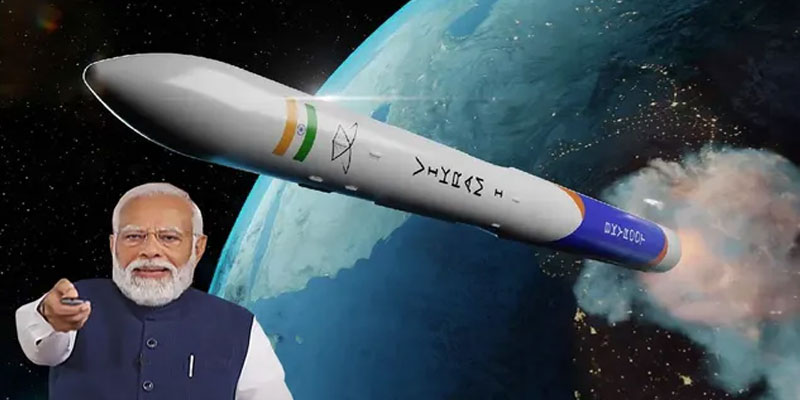
Vikram-I, developed by Skyroot Aerospace, represents a major milestone for India’s private space sector — a fully homegrown orbital-class launch vehicle designed for rapid, cost-efficient satellite deployment.
Vikram-I stands about 20 meters tall and 1.7 meters wide, built using an all-carbon-fibre composite structure that keeps the rocket lightweight yet strong. It uses a four-stage propulsion system — three solid-fuel stages followed by a final liquid-fuel stage — specially designed to carry small satellites to orbit.
-
First stage (Kalam-1200): A solid-fuel booster producing massive thrust (≈ 120 tonnes) to lift the rocket off the pad.
-
Upper stages and final stage: Include solid-fuel motors and a restartable liquid-fuel engine (Raman engine), enabling precise orbit placement and flexibility for missions.
In terms of payload capacity, Vikram-I can deliver up to ≈ 350–480 kg to Low Earth Orbit (LEO), or ≈ 260–290 kg to a Sun-Synchronous Orbit (SSO), depending on the mission profile.
Beyond raw specs, Vikram-I is built for flexibility, speed and affordability — enabling dedicated or rideshare satellite launches on demand, and lowering barriers for private and institutional satellite operators.
By combining lightweight materials, modern propulsion, and small-satellite focus, Vikram-I aims to transform how India — and global customers — access space, adding a strong private-sector complement to traditional national launch providers.