Prime Minister Narendra Modi will begin a three-day official visit to Australia from July 8 to 10, with economic cooperation expected to feature prominently on the bilateral agenda. The visit comes at a time when India and Australia have transformed their relationship into one of the Indo-Pacific's most dynamic economic partnerships. Bilateral trade has grown steadily, the Economic Cooperation and Trade Agreement (ECTA) is already delivering tangible benefits, and negotiations for the more comprehensive Economic Cooperation Agreement (CECA) continue to progress. Together, these developments reflect a partnership that is increasingly driven by trade, investment, technology and strategic convergence.
India-Australia Partnership Evolves Beyond Strategic Ties
The India-Australia relationship has undergone a significant transformation over the past decade. While defence and security cooperation remain important pillars, both countries have steadily expanded collaboration in trade, critical minerals, education, renewable energy, technology and investment.
Australia identified India as a priority economic partner through its India Economic Strategy to 2035, first unveiled in 2018 and updated in 2022. Simultaneously, Indian industry has consistently advocated deeper commercial engagement with Australia to diversify export markets and strengthen supply chains.
This broader policy framework has shifted the relationship beyond traditional diplomacy, positioning both countries as key economic partners in building a resilient and diversified Indo-Pacific.
ECTA Delivers Early Trade Benefits
A major milestone was achieved with the entry into force of the Economic Cooperation and Trade Agreement (ECTA) on December 29, 2022. The agreement has substantially reduced tariffs, with around 90 per cent of Australian goods exports by value to India now entering duty-free, while additional tariff reductions have benefited several agricultural products.
The agreement has also strengthened India's export performance. Merchandise trade between the two countries reached approximately US$24.1 billion during 2024-25, reflecting sustained commercial engagement across diverse sectors.
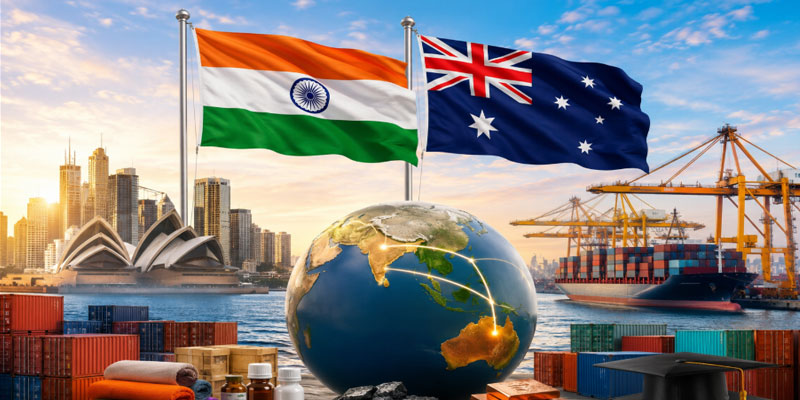
Indian exports to Australia include refined petroleum products, pharmaceuticals, engineering goods, gems and jewellery and textiles, while Australia supplies coal, natural gas, copper ores, critical minerals and education services. This complementary trade structure supports India's industrial growth while providing Australia with access to one of the world's fastest-growing consumer markets.
CECA Remains the Next Major Milestone
While ECTA has addressed tariff liberalisation, the proposed Comprehensive Economic Cooperation Agreement (CECA) seeks to create a much deeper economic framework.
Negotiations have now completed 11 rounds, with the latest discussions covering market access for goods and services, digital trade, investment rules, rules of origin and institutional mechanisms. Although substantial progress has been made, several sensitive issues—including services liberalisation, professional mobility and sector-specific market access—continue to require careful negotiation.
A successful CECA would significantly broaden opportunities for businesses by facilitating greater investment, expanding digital commerce and improving mobility for skilled professionals.
Growing Economic Partnership Reflects Strategic Convergence
The evolution of India-Australia trade reflects wider geopolitical realities. Both nations increasingly view economic cooperation as an essential component of Indo-Pacific resilience, reducing supply-chain vulnerabilities and strengthening trusted partnerships.
High-level ministerial engagements, including the 19th Joint Ministerial Commission meeting held in Adelaide in August 2024, have maintained momentum towards deeper commercial integration and policy coordination.
From Trade Potential to Economic Integration
Prime Minister Modi's visit comes at a pivotal moment in India-Australia relations. ECTA has already demonstrated the value of practical trade liberalisation by expanding commerce and improving market access, while CECA offers the prospect of a far more comprehensive economic partnership. If negotiations conclude successfully, the agreement could deepen investment, facilitate greater movement of professionals and strengthen cooperation across emerging sectors. As both countries navigate an evolving Indo-Pacific landscape, sustained economic integration will remain central to transforming a strong bilateral relationship into a long-term strategic and commercial partnership.
(With agency inputs)