Trump’s Remarks Deepen Rift with Italy’s Prime Minister
US President Donald Trump has reignited his public feud with Italian Prime Minister Giorgia Meloni just days before the NATO summit, injecting fresh uncertainty into an already sensitive diplomatic environment. What began as a dispute over an alleged interaction at the recent G7 Summit has evolved into a broader clash over political conduct, public messaging and respect between allies. Trump’s latest social media posts, including a meme targeting Meloni, have intensified the controversy and shifted attention from strategic cooperation to personal confrontation. The episode reflects how political rivalries increasingly play out on digital platforms, often influencing perceptions of international partnerships.
A Dispute Over a G7 Encounter
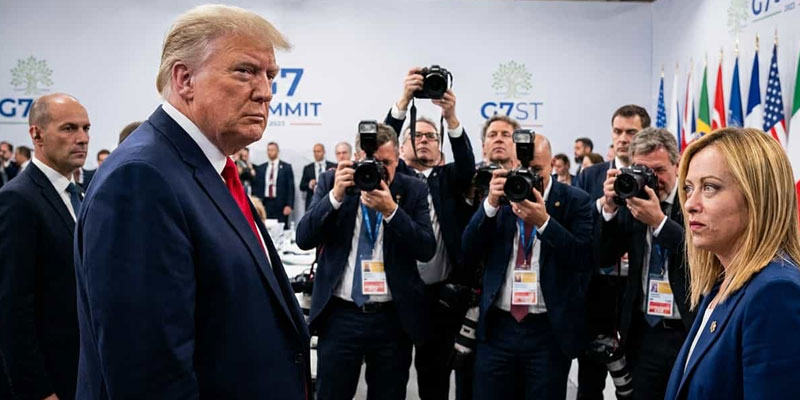
The disagreement traces back to Trump's claim that Meloni repeatedly asked for a photograph with him during the recent G7 Summit in France. Speaking in interviews and later on social media, Trump asserted that the Italian Prime Minister had "begged" for a picture. Meloni firmly rejected the allegation, describing it as "completely fabricated" and expressing surprise that a prominent American political leader would make such remarks about the head of government of a close ally.
The dispute quickly moved beyond personal disagreement. Reports that Italy's Foreign Minister cancelled a planned visit to the United States suggested that the controversy had begun affecting official diplomatic interactions, raising concerns about its broader implications for bilateral relations.
Escalation Through social media
The latest escalation came when Trump shared a meme on his Truth Social platform portraying himself as seeking a restraining order against Meloni. The post implied that the Italian leader had been excessively eager for his attention, reinforcing Trump's earlier narrative. He also circulated a digitally altered image involving former President Barack Obama and former First Lady Michelle Obama, further highlighting his continued reliance on provocative online messaging.
The episode illustrates Trump's long-established communication style, in which political disagreements are frequently transformed into highly visible social media confrontations. By blending humour, satire and personal criticism, such messaging often attracts widespread attention while simultaneously intensifying political divisions.
Why the Timing Matters
The timing of the renewed dispute is particularly significant. The controversy comes ahead of a NATO summit where allied governments are expected to discuss defence spending, continued support for Ukraine, Indo-Pacific security, and broader transatlantic cooperation. At a moment when unity among NATO members remains crucial, public disagreements between influential political figures risk distracting from substantive policy discussions.
Italy has emerged as one of Washington's important European partners under Meloni's leadership, particularly on security and strategic issues. Public criticism directed at the Italian Prime Minister therefore carries implications beyond personal reputation, potentially complicating the atmosphere of trust and cooperation that alliances depend upon.
For her part, Meloni has largely sought to contain the controversy by rejecting Trump's claims while emphasising the importance of mutual respect between allies. This approach enables her to defend her credibility domestically without allowing the dispute to overshadow Italy's broader strategic relationship with the United States.
Diplomacy Should Rise Above Personal Rivalries
The Trump-Meloni controversy highlights how modern diplomacy is increasingly shaped by personalities and social media as much as formal negotiations. While political disagreements are inevitable, public exchanges that undermine allied leaders can weaken confidence and distract from pressing global challenges. As NATO members prepare to address complex security issues, the episode serves as a reminder that durable international partnerships depend not only on shared strategic interests but also on mutual respect, responsible communication and the ability to place collective objectives above individual political rivalries.
(With agency inputs)