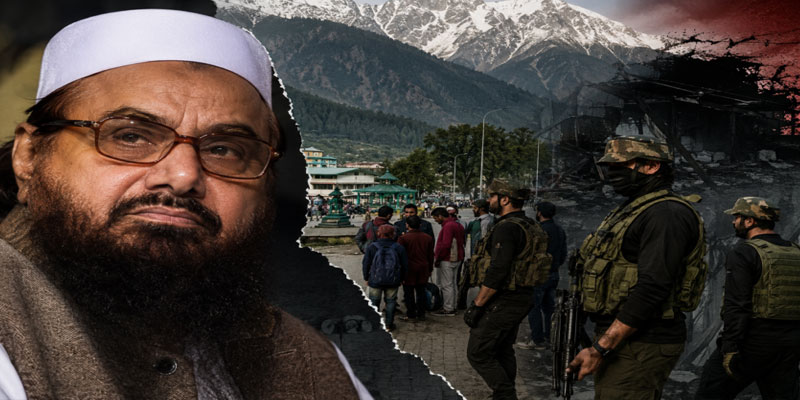
Charge Sheet Broadens the Scope of the Investigation
The National Investigation Agency’s (NIA) supplementary charge sheet naming Hafiz Saeed in connection with the April 22, 2025, Pahalgam terror attack marks a significant development in India's investigation into one of the deadliest civilian attacks in recent years. By identifying the chief of Lashkar-e-Taiba (LeT) not only in his individual capacity but also as the head of LeT and its proxy outfit, The Resistance Front (TRF), the agency has expanded the case beyond the immediate perpetrators to the alleged masterminds behind the attack. The move reflects an effort to establish that the assault was part of a larger Pakistan-backed conspiracy rather than an isolated act of terrorism carried out by local operatives.
The Pahalgam Attack and Earlier Investigation
The Pahalgam terror attack claimed the lives of 26 civilians and was described by the NIA as a religion-based targeted attack orchestrated by Pakistan-sponsored terrorists. Following months of investigation, the agency had earlier filed a charge sheet naming Pakistan-based handler Sajid Jatt, three terrorists who were later killed during Operation Mahadev near Srinagar, and two local accused allegedly involved in sheltering and assisting the attackers.
The investigation reportedly uncovered communication networks, logistical support channels and operational links connecting the attackers with handlers based across the border. The supplementary charge sheet now extends that investigative framework by placing Hafiz Saeed at the centre of the alleged conspiracy.
Updated Investigation: Expanding the Accountability Chain
The latest filing seeks to widen the scope of legal accountability from those who executed the attack to those accused of planning, directing and supporting it. The NIA has invoked provisions of the Bharatiya Nyaya Sanhita (BNS) and the Unlawful Activities (Prevention) Act (UAPA), alleging offences relating to criminal conspiracy, waging war against India and terrorist activities.
By naming Hafiz Saeed as a principal accused, investigators aim to demonstrate that the attack formed part of a structured cross-border terror network involving operational handlers, financial support mechanisms and ideological leadership. According to the agency, the supplementary charge sheet completes the investigative chain by linking local logistical support with alleged command and control structures operating from Pakistan.
The move is also significant because it strengthens India's legal documentation of the case, creating a formal record that may support future judicial proceedings and international diplomatic efforts relating to cross-border terrorism.
What Critics Say
Security analysts view the supplementary charge sheet as an important step in formally attributing responsibility for the attack to senior leadership within Pakistan-based terrorist organisations. They argue that establishing command responsibility is critical in terrorism cases because proving the role of planners and financiers often carries greater strategic significance than identifying the attackers alone.
At the same time, some legal observers note that naming individuals located outside India's jurisdiction presents practical challenges for prosecution and enforcement. They emphasise that while the charge sheet strengthens India's legal position, successful judicial outcomes will ultimately depend on the evidence presented before the courts and the broader framework of international cooperation in counterterrorism.
Building a Comprehensive Legal and Strategic Case
The NIA's supplementary charge sheet represents more than an expansion of the list of accused; it reflects an effort to construct a comprehensive legal narrative linking field operatives, local facilitators and alleged cross-border masterminds within a single conspiracy. By placing Hafiz Saeed at the centre of the case, the agency seeks to reinforce India's longstanding position on Pakistan-based terrorism while strengthening the legal foundation for future prosecutions and international engagement. The development underscores India's continuing focus on ensuring that accountability extends beyond those who execute terrorist attacks to those accused of planning, financing and directing them.
(With agency inputs)