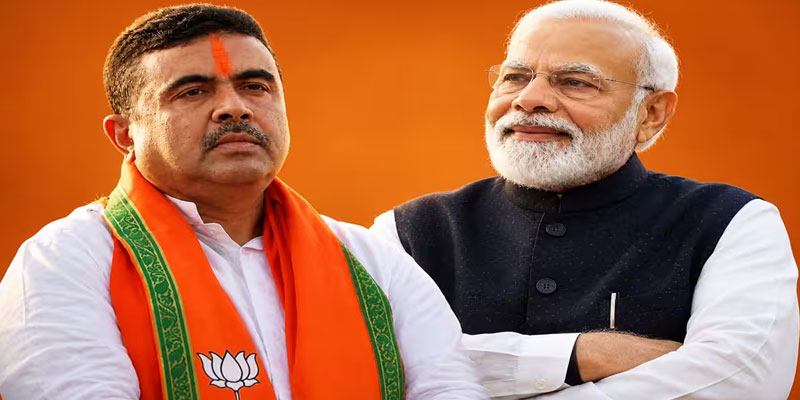
BJP’s Bengal Transition Appears to Centre Around Suvendu Adhikari
Suvendu Adhikari has emerged as the strongest contender to become the next Chief Minister of West Bengal, with growing indications that the BJP leadership has largely settled on him as the face of its first government in the state. Adding to the political buzz are reports that the new administration may include two deputy chief ministers — including one woman leader — in an effort to balance regional, caste and gender equations.
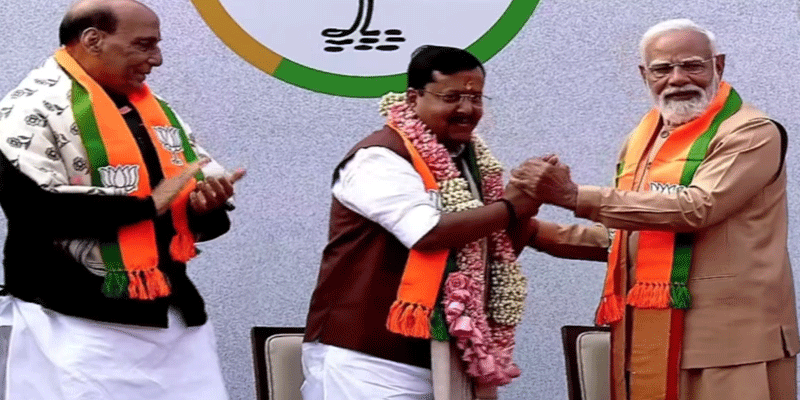
The speculation intensified following the arrival of Union Home Minister Amit Shah in Kolkata as the BJP’s central observer for the legislature party meeting. His public gestures towards Adhikari, widely viewed as deliberate political signalling, have strengthened perceptions that the BJP is preparing cadres and allies for a leadership transition centred around the former Trinamool Congress heavyweight.
Why Suvendu Adhikari Has Emerged as the Frontrunner
Adhikari’s rise within the BJP has been closely tied to the party’s expansion in Bengal over the past several years. Once a trusted lieutenant of Mamata Banerjee and a key architect of the Trinamool Congress’s 2011 victory, he later crossed over to the BJP and reinvented himself as her most aggressive political challenger.
Two developments have particularly strengthened his claim to the chief minister’s post. First is his electoral symbolism. Adhikari defeated Mamata Banerjee in Nandigram during the 2021 elections and is now credited with leading the BJP’s successful campaign in the latest assembly battle, including victories in politically symbolic constituencies such as Bhabanipur. Within BJP circles, this has elevated him as the face of “real poribartan” — a deeper political shift beyond the original anti-Left transition of 2011.
Second is his organisational influence. Adhikari commands strong political networks across East Midnapore, South Bengal and large sections of the rural electorate. These networks helped the BJP penetrate areas where it previously lacked grassroots structure.
Amit Shah’s Visit and the Political Messaging
The strongest signal so far has come from Amit Shah’s visibly warm public engagement with Adhikari during his Kolkata visit. In BJP political culture, symbolic gestures often carry strategic meaning. Observers noted that Shah’s public applause and repeated acknowledgment of Adhikari stood out compared to his interactions with other state leaders.
At the same time, party insiders have hinted that the incoming cabinet will combine experienced leaders with fresh faces, while repeatedly describing Adhikari as “among the frontrunners” for the top post. Such phrasing is widely interpreted as carefully calibrated messaging from the central leadership rather than informal speculation.
Why BJP May opt for Two Deputy Chief Ministers
Reports suggest the BJP is considering appointing two deputy chief ministers to widen the government’s social and regional representation. One deputy CM is expected to be a woman leader, a move aimed at challenging Mamata Banerjee’s long-standing appeal among women voters.
The second deputy CM could come from North Bengal or tribal-dominated regions, reflecting the BJP’s growing support in those areas and its effort to strengthen outreach among backward-caste and tribal communities. Such a structure would allow the BJP to project inclusiveness while balancing internal factions and regional aspirations.
A Defining Moment for Bengal Politics
If Suvendu Adhikari is ultimately chosen as chief minister, the BJP will be making a powerful political statement. The elevation of a leader who directly challenged and defeated Mamata Banerjee symbolises the party’s attempt to establish a new political order in Bengal.
Yet the challenges ahead remain immense. The state remains deeply polarised, the outgoing ruling establishment continues to question the mandate, and factional pressures within the BJP itself could intensify once power-sharing negotiations begin.
Whether Adhikari and his proposed deputy chiefs can convert electoral victory into stable governance will determine not only the future of the BJP in Bengal, but also whether the state enters a period of political consolidation or prolonged confrontation.
(With agency inputs)