Vijay Moves to Freeze Lok Sabha Strength
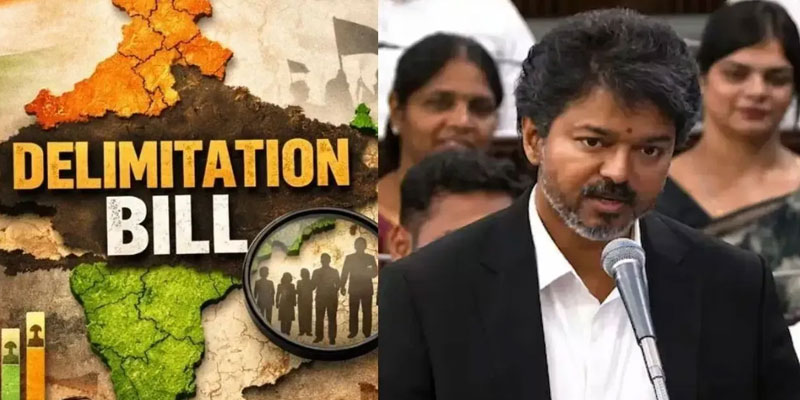
Tamil Nadu Chief Minister C. Joseph Vijay has moved a resolution in the state Assembly urging the Centre to permanently retain the Lok Sabha’s present strength of 543 seats and implement 33% reservation for women from the 2029 general election using the existing constituencies. The move directly challenges the proposed delimitation framework and places Tamil Nadu at the centre of a larger confrontation over representation, federalism and population policy.
Why Delimitation Has Become Politically Explosive
Delimitation is intended to redraw electoral constituencies so that parliamentary representation broadly reflects population distribution. India’s existing allocation freeze was rooted in the 1971 Census and extended by the 84th Constitutional Amendment until the first Census conducted after 2026, largely to encourage states to pursue population stabilisation.
The Centre introduced the Constitution (131st Amendment) Bill, 2026 and the Delimitation Bill in April, proposing to enable delimitation using the latest published Census and potentially raise the Lok Sabha’s maximum strength from 550 to 850 members, including up to 815 seats for states and 35 for Union Territories.
However, the constitutional amendment failed to secure the required special majority in the Lok Sabha on April 17, after which the government withdrew the related delimitation legislation. Therefore, the immediate legislative proposal is no longer pending in its original form, but the political dispute over future delimitation remains intense.
South Fears Population Success Could Become Punishment
Tamil Nadu and other southern states argue that population-based redistribution could disadvantage regions that successfully reduced fertility and population growth. Their concern is straightforward: if parliamentary seats increasingly track population, states with faster demographic expansion could gain political weight, while states that invested earlier in population stabilisation could see their relative influence diminish.
The issue is therefore not merely about constituency boundaries. It raises a fundamental federal question: should electoral representation reward population size alone, or also recognise states’ contribution to national population-control objectives?
Vijay’s Four-Point Federal Challenge
Vijay’s resolution seeks four safeguards.
· First, it calls for the Lok Sabha’s strength to remain permanently fixed at 543.
· Second, it seeks protection of the existing proportion of seats allotted to individual states, preventing demographic differences from substantially altering their parliamentary share.
· Third, it seeks preservation of the existing Lok Sabha–Rajya Sabha representation balance.
· Fourth, and significantly, it wants one-third reservation for women to begin in 2029 itself, using the existing 543 constituencies rather than making women’s representation dependent on fresh delimitation.
Federalism And Gender Justice Collide
The controversy has produced an unusual political convergence in Tamil Nadu, where parties that often compete sharply have expressed concern over a population-driven redistribution of parliamentary seats. The debate now combines regional representation, constitutional federalism and gender justice.
Representation Must Not Become a Federal Penalty
The delimitation dispute ultimately asks how India should balance “one person, one vote” with the federal compact. Population must matter in a representative democracy, but so must the constitutional promise that states pursuing responsible demographic policies should not be politically penalised. Vijay’s resolution therefore goes beyond Tamil Nadu’s immediate interests: it demands a national consensus ensuring that democratic expansion does not inadvertently become a mechanism for weakening the voice of successful states.
(With agency inputs)