Tata Consultancy Services Chairman N. Chandrasekaran has signaled a major transformation in the future of India’s technology industry, stating that the company could soon have an equal number of AI agents and human employees within the next three years. Speaking at TCS’ 31st Annual General Meeting on June 9, 2026, Chandrasekaran said artificial intelligence will increasingly automate tasks currently handled by workers, leading IT firms to slow hiring rather than pursue large-scale layoffs.
The remarks reflect a broader shift underway across the global technology sector, where AI-driven automation is rapidly reshaping business models, workforce structures and enterprise operations.
AI Becomes Central to TCS’ Future Strategy
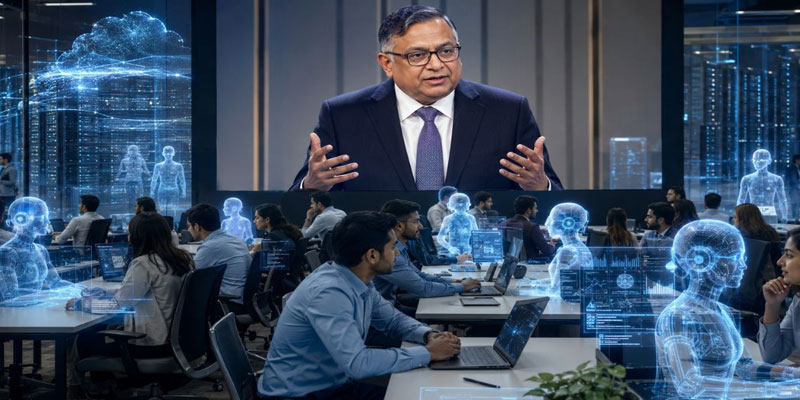
During the AGM, Chandrasekaran outlined TCS’ long-term vision of a hybrid workforce where human employees and AI agents collaborate across projects and operations. He stated that if the company currently employs around half a million people, the time is not far when it could deploy an equal number of AI agents.
According to him, the future of the IT industry will not be defined solely by human labour but by the integration of intelligent AI systems capable of handling repetitive, analytical and operational tasks at scale.
At the same time, Chandrasekaran emphasized that TCS does not intend to replace employees outright through layoffs. Instead, hiring is expected to moderate as AI tools gradually absorb portions of existing workloads.
India’s IT Industry Faces Structural Transformation
The comments come at a time when India’s $315-billion IT industry is confronting major structural disruption. For decades, the sector’s growth relied heavily on labour-intensive outsourcing models, employing millions of engineers and software professionals.
However, the rise of advanced generative AI systems is challenging this traditional approach. Companies worldwide are increasingly using AI for coding, customer support, analytics, testing and workflow automation — reducing dependence on large human teams for routine tasks.
The shift has also coincided with weaker global technology spending and geopolitical uncertainty, both of which have affected client demand for Indian IT services. Investors have grown increasingly concerned about whether India’s outsourcing giants can maintain growth while adapting to AI-led transformation.
Workforce Reductions and Market Concerns
Although TCS has ruled out mass layoffs, the company has already witnessed a decline in headcount over the past year. In July 2025, TCS cut more than 12,000 jobs, mainly at middle and senior management levels. By the end of FY26, the company’s workforce had fallen by over 23,000 employees, bringing total headcount to approximately 5.84 lakh workers.
Industry analysts attribute the reductions to evolving business needs, automation pressures and skill mismatches in an AI-driven environment.
The market reaction has also been significant. TCS shares have declined sharply in 2026 amid investor worries over AI’s impact on labour-intensive business models. Yet, the company’s AI-related business continues to grow rapidly, with annualized AI revenues crossing $2.3 billion by March 2026.
TCS currently works with more than 130 major clients on AI transformation initiatives, positioning artificial intelligence as a core growth engine rather than merely a cost-cutting tool.
AI-Human Collaboration Reshaping Technology Employment
Chandrasekaran’s vision highlights a larger industry trend where AI is increasingly viewed as a collaborative workforce layer rather than a standalone replacement for human talent. The future workplace, according to TCS, will involve humans focusing on creativity, decision-making and complex problem-solving while AI agents manage automation-heavy processes.
India’s IT Industry Enters the AI Era
The TCS chairman’s remarks underline a pivotal moment for India’s technology sector. Artificial intelligence is no longer a distant disruption but a present reality reshaping hiring patterns, workforce structures and business strategies across the IT industry.
While fears of widespread job losses persist, the transition may ultimately depend on how effectively companies retrain employees and adapt skills to an AI-driven economy. For India’s IT sector, the challenge now lies not only in embracing automation but in ensuring that human talent evolves alongside it.
(With agency inputs)