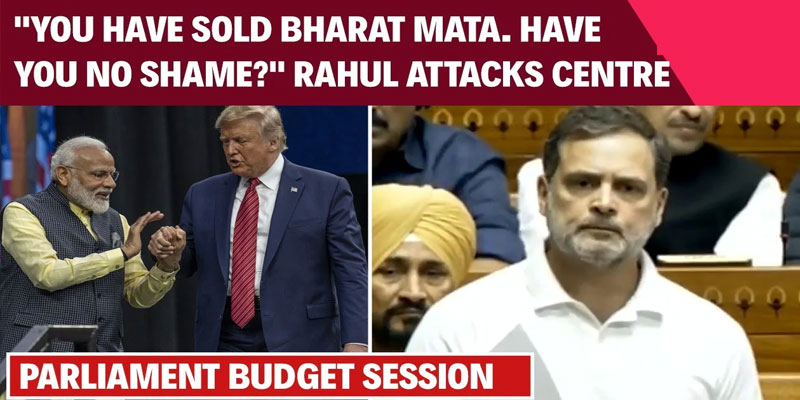
Fiery Allegation Over India–US Deal
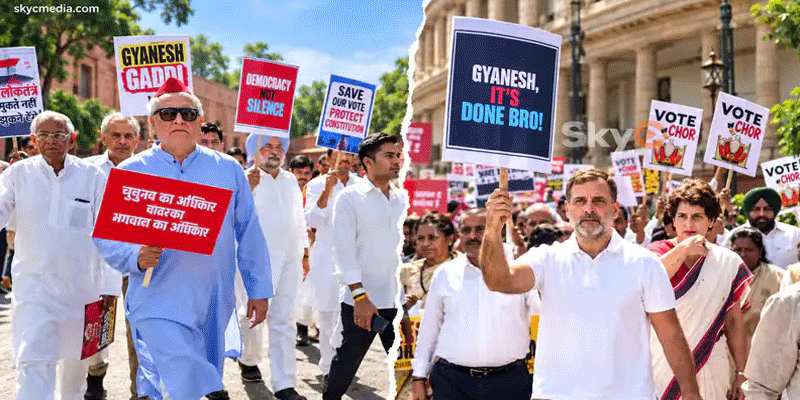
Congress leader Rahul Gandhi has accused the government of “selling Bharat Mata” through the proposed India–US trade arrangement, triggering sharp exchanges in Parliament and beyond. His remarks, delivered during a heated session, framed the agreement as detrimental to farmers and domestic industries. The accusation quickly became a focal point of political debate, with ruling party leaders rejecting the charge and defending the deal as beneficial for India’s economy.
Trade Policy Turns into Political Flashpoint
The interim trade framework between India and the United States has become a new battleground in domestic politics. While the government portrays the agreement as a pragmatic step to boost trade and avert tariff disputes, opposition leaders have questioned its implications for agriculture, data security, and economic sovereignty. Gandhi’s comments reflect broader concerns within opposition ranks that global trade negotiations may disadvantage vulnerable sectors at home.
Rahul Gandhi’s Critique and Political Framing
Gandhi argued that the agreement could expose Indian farmers and small industries to increased competition from subsidised American products. He suggested that concessions on market access and procurement commitments could undermine rural livelihoods and weaken domestic production. His speech also touched on concerns about data governance and strategic dependence, linking the trade framework to wider economic and geopolitical questions.
The use of emotive language, including the “sold Bharat Mata” phrase, was intended to underscore what he described as the gravity of the situation. By framing the issue in nationalistic terms, Gandhi sought to rally opposition parties and mobilise public sentiment, particularly in agrarian regions where trade liberalisation often generates anxiety.
Government and BJP Response
The government and Bharatiya Janata Party (BJP) leaders responded swiftly, dismissing the allegations as unfounded and politically motivated. Parliamentary Affairs Minister Kiren Rijiju stated that India’s sovereignty and economic interests were not compromised, arguing that the agreement aims to expand exports and create opportunities for domestic industries.
Other BJP leaders echoed this stance, emphasising that the framework includes safeguards for sensitive sectors and is designed to strengthen bilateral trade without binding India to specific concessions that would harm farmers. Party spokespersons also pointed to the potential benefits of increased market access for Indian goods and the avoidance of retaliatory tariffs.
Several leaders criticised Gandhi’s rhetoric as exaggerated, accusing the opposition of attempting to create fear around economic reforms. The ruling party framed the deal as part of a broader strategy to enhance India’s global trade position while maintaining policy flexibility.
Political and Economic Implications
The dispute highlights how trade agreements can quickly become politicised, especially when they intersect with domestic concerns such as agriculture and employment. For the opposition, the issue provides an opportunity to question the government’s economic priorities and rally support among key constituencies. For the ruling party, defending the agreement reinforces its narrative of strong leadership and economic pragmatism.
Trade Debate Reflects Wider Political Contest
The clash over the India–US trade framework illustrates the intersection of economic policy and political messaging. While the government emphasises strategic gains and economic opportunity, the opposition warns of potential risks to domestic sectors. As negotiations continue and details emerge, the debate is likely to intensify. Ultimately, the controversy underscores the need for transparency and consensus-building in trade policymaking, ensuring that international agreements balance growth ambitions with protection for vulnerable communities.
(With agency inputs)