The Retirement Age Debate and the Leadership Question
The question of when political leaders should step aside has once again come to the fore—this time not in whispers, but from the highest ideological pulpit of the ruling party’s parent organisation. Rashtriya Swayamsevak Sangh (RSS) chief Mohan Bhagwat, in a pointed remark delivered in Hindi during a Marathi speech, stated that leaders ought to consider retirement upon turning 75. Coming just months before Prime Minister Narendra Modi reaches that age, Bhagwat's comment has triggered quiet speculation across political circles. Is this a cue for leadership transition—or merely an affirmation of institutional values within the Sangh Parivar?
The BJP, often hailed for its structured approach to leadership and cadre-building, has in the past seen age-related exits of senior leaders like L.K. Advani and Murli Manohar Joshi. But it also has one clear anomaly: Narendra Modi. The question is not just whether Bhagwat’s comment was aimed at him—but whether, in Modi’s BJP, age-limits are still relevant.
Bhagwat’s Signal—A Reminder, not a Directive
Bhagwat’s statement was carefully crafted. It wasn’t a spontaneous aside, nor vague enough to be misinterpreted. By breaking into Hindi mid-speech solely to deliver that point, the RSS chief ensured it landed with weight. Yet, there’s caution in reading this as a direct signal to Modi. Within the Sangh-BJP framework, precedent suggests otherwise: such signals are long-term nudges rather than immediate orders.
Historical parallels abound. In 2005, then-RSS chief K.S. Sudarshan had made similar remarks, urging veterans Vajpayee and Advani to make way for younger leaders. That remark sparked hushed backlash but planted seeds of change that eventually led to the rise of a new generation, including Narendra Modi. Bhagwat’s remark today may function similarly—not to displace Modi in 2024, but to prepare the ground for a succession sometime thereafter.
The Modi Exception—When Rules Don’t Apply
The BJP under Modi has evolved into a tightly controlled political machine with a clearly centralised power structure. While the ‘retirement at 75’ principle was cited to bench stalwarts like Advani and Joshi, it has not been institutionalised. Modi himself brought back or retained leaders like Najma Heptulla and Hema Malini despite their age, suggesting the rule is applied selectively—when convenient, not doctrinally.
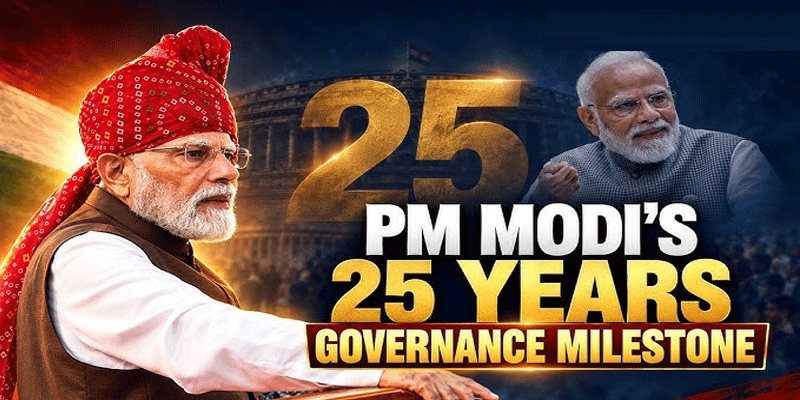
Modi turns 75 in September 2025 and has given no indication of slowing down. His fitness, popularity, and iron grip over both the party and government virtually eliminate the chance of a forced or even gently suggested retirement. Barring a dramatic shift, he is expected to lead the BJP into the 2029 general elections. In this sense, he is the Modi Exception—possibly the only one who can override the institutional expectations of the RSS, because he has redefined what leadership means within the Sangh ecosystem.
BJP’s Leadership Model—Meritocracy Over Dynasty
Despite this exception, the BJP’s leadership model remains strikingly different from its rivals. From Vajpayee’s era onwards, the party has consistently promoted younger leaders—often as chief ministers and party presidents. Modi himself was appointed Gujarat CM at 51. BJP presidents like Nitin Gadkari, Amit Shah, and J.P. Nadda were all in their 40s or 50s when they took charge. In contrast, the Congress has retained older leadership, with Sonia Gandhi and now Mallikarjun Kharge remaining at the helm well into their 70s and 80s.
This emphasis on youth and merit has kept the BJP’s bench strength robust and allowed smoother transitions at state levels. The average age of new BJP CMs post-2014 has been around 51. And while dynasts exist within the BJP, none have risen to power solely on family credentials. This structural strength is a key reason why the RSS believes it can afford to signal generational change without destabilising the system.
RSS Walks the Talk on Age
The RSS itself has largely practiced what it now preaches. Its past chiefs—from M.S. Golwalkar to Rajendra Singh and K.S. Sudarshan—either died young or voluntarily stepped aside around the age of 75. If Bhagwat retires this September, upon turning 75, he will be seen as reinforcing that same culture of self-limitation. His decision could therefore become the symbolic benchmark that reignites discussion within the BJP about age, succession, and institutional discipline—even if Modi continues unchallenged.
Between Tradition and Transformation
Mohan Bhagwat’s comment is not a command—it’s a cultural reminder. It urges a system built on discipline and ideology to look ahead, to prepare, and to empower the next generation. But Modi’s dominance complicates this otherwise clean arc of succession. He is the towering figure around whom contemporary BJP politics revolves. The Sangh may set philosophical boundaries, but Modi sets the practical ones.
What lies ahead, therefore, is a phase of silent calibration. There won’t be open power struggles or public demands for leadership change. But subterranean movements—rising leaders, shifting allegiances, new alignments—may already be underway. Whether 75 becomes a real turning point will depend less on rules and more on one man’s will.
Until then, the RSS may talk of time limits—but only Modi controls the clock.
(With agency inputs)