Supply Shock and a Temporary US Waiver
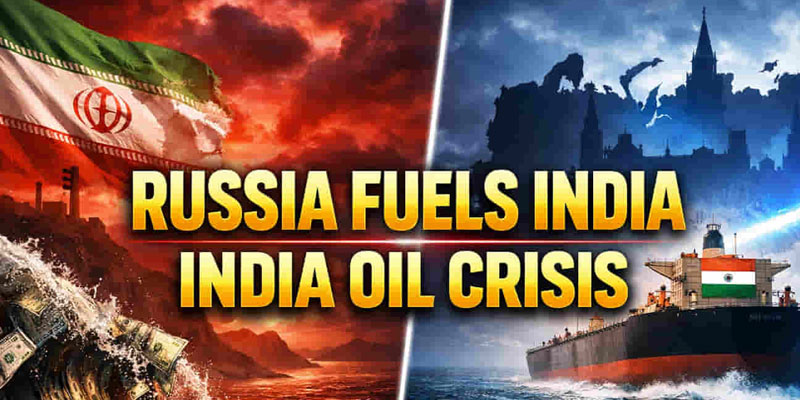
Indian refiners are moving quickly to secure prompt Russian crude cargoes as the ongoing US–Iran War disrupts energy flows across West Asia. The conflict has sharply curtailed shipments through the Strait of Hormuz, one of the world’s most critical oil chokepoints.
Amid the disruption, the US Department of the Treasury issued a limited 30-day waiver on March 5, 2026, allowing India to purchase Russian crude cargoes already stranded at sea. The temporary relief is designed to stabilize global oil markets while maintaining broader sanctions pressure on Russia following the Russian invasion of Ukraine.
Iran Conflict Disrupts Gulf Oil Flows
The escalating conflict has severely disrupted tanker movements in the Gulf region. With Iran effectively restricting access through the Strait of Hormuz, shipping companies report damaged vessels, rerouted routes, and surging insurance premiums.
For India, the risk is significant. Nearly 40 percent of its crude imports—around 2.5 to 2.7 million barrels per day—normally pass through the strait from suppliers such as Iraq, Saudi Arabia, United Arab Emirates, and Kuwait.
While India’s diversified sourcing prevents an immediate shortage, the disruption raises concerns over price volatility and inflation. Liquefied natural gas shipments—also heavily dependent on Hormuz routes—face similar risks, adding to the pressure on India’s broader energy security.
Russian Cargoes Provide Immediate Relief
To offset the supply gap, Indian state refiners—including Indian Oil Corporation, Bharat Petroleum, Hindustan Petroleum, and Mangalore Refinery and Petrochemicals Limited—have secured roughly 20 million barrels of prompt Russian crude.
These purchases prioritize availability over discounts, reflecting the urgency of replacing disrupted Gulf supplies. Russia’s seaborne surplus, created after Western sanctions reshaped global oil flows, has provided India with a flexible fallback option.
Although India had reduced Russian imports in recent years to maintain trade balance with the United States, the waiver now allows refiners to tap cargoes already loaded before March 5 and delivered by April 4.
Building Stronger Strategic Oil Reserves
The crisis has also highlighted India’s relatively limited emergency stockpiles. Currently, the country’s Indian Strategic Petroleum Reserves Limited maintains reserves covering about 9.5 days of demand. Combined with commercial inventories held by oil companies, total available stocks amount to roughly 74 days—still short of the 90-day benchmark recommended by the International Energy Agency.
To address this gap, the government is accelerating Phase II strategic petroleum reserve expansion projects at Chandikhol and Padur. These facilities will add 6.5 million metric tonnes of storage capacity under a public-private partnership model, pushing total reserves to about 12 MMT—enough to cover more than 20 days of demand independently.
Beyond this, New Delhi is planning an additional 6 MMT reserve buildout, with cabinet approval expected by mid-2026. Petroleum Minister Hardeep Singh Puri has emphasized that the expansion is crucial for handling disruptions such as potential Hormuz closures.
Parallel initiatives include diversifying imports from the United States and Latin America, along with boosting domestic exploration through “Mission Samudra Manthan,” which aims to expand deep-water drilling to 100 wells annually from 2026–27.
Energy Security in a Volatile World
India’s swift shift toward Russian crude underscores a pragmatic approach to energy security during geopolitical crises. The US waiver offers temporary breathing room, but the broader lesson is clear: reliance on narrow shipping corridors like the Strait of Hormuz leaves major economies vulnerable.
By expanding strategic reserves, diversifying suppliers, and investing in domestic exploration, India is attempting to transform a moment of crisis into an opportunity to strengthen long-term resilience in its energy supply chain.
(With agency inputs)