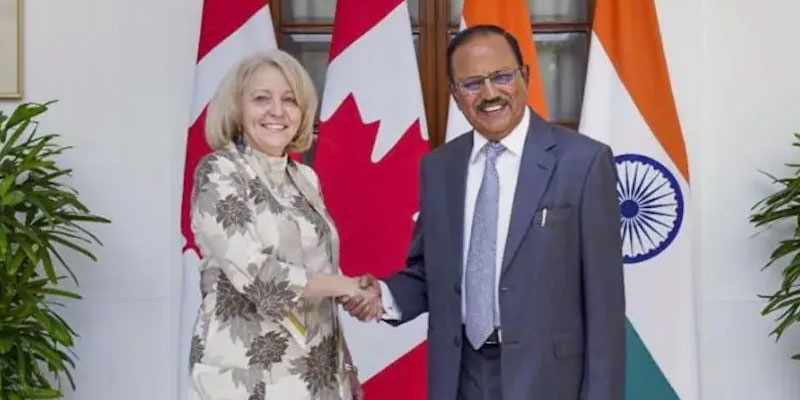
National Security Adviser Ajit Doval met his Canadian counterpart, Nathalie Drouin, in Ottawa for talks that signalled a cautious reset in bilateral ties. Both sides agreed to deploy dedicated security and law-enforcement liaison officers in each other’s countries, a move intended to enable faster intelligence exchange and closer coordination against transnational threats. The meeting marked one of the most consequential high-level engagements since relations deteriorated sharply in recent years.
From Diplomatic Crisis to Gradual Thaw
India–Canada relations plunged after June 2023, when Canadian Prime Minister Justin Trudeau publicly alleged Indian involvement in the killing of Hardeep Singh Nijjar, a pro-Khalistan figure shot in Surrey, British Columbia. New Delhi rejected the accusation as baseless and politically motivated. The fallout was swift: diplomats were expelled, visa services slowed or halted, and trade negotiations stalled despite bilateral commerce worth billions. Tensions deepened through 2024 with reciprocal expulsions and travel disruptions. A political transition in Ottawa in 2025 and quieter diplomacy since then have created space for cautious engagement, though distrust remains—particularly around extremist networks and diaspora politics.
A Strategic Reset: Outcomes of the Doval–Drouin Talks
The February 2026 meeting produced a practical roadmap for rebuilding cooperation without directly resolving the political dispute. The most notable outcome was the decision to station liaison officers from security and law-enforcement agencies in each other’s capitals. These officials will coordinate intelligence on organised crime, extremist financing, immigration fraud, and narcotics trafficking.
The arrangement is designed to cut bureaucratic delays in information sharing and create direct channels between agencies such as India’s Intelligence Bureau and Canada’s RCMP. Alongside this, both sides agreed to develop a joint work plan prioritising counter-terrorism, criminal networks, and digital security threats. The visit also laid groundwork for further political engagement, with expectations that senior Canadian leadership will travel to India later in 2026.
Addressing Khalistani Networks Through Liaison Officers
The liaison-officer mechanism is expected to play a central role in tackling concerns over Khalistani extremism, a persistent irritant in bilateral ties. India has long accused some groups operating from Canadian soil of financing or inciting violence, while Canada has emphasised legal standards and freedom of expression. Embedding officers from each country aims to bridge this gap by allowing real-time sharing of intelligence on suspected funding channels, recruitment efforts, and propaganda networks.
Through coordinated investigations and evidence exchange say officials hope to facilitate prosecutions or preventive measures where legally viable. Monitoring of financial transfers, community events, and online activity linked to proscribed organisations will likely form part of the cooperation framework. Ottawa’s willingness to publicly distance itself from extremist elements signals a shift toward addressing India’s longstanding concerns while balancing domestic political sensitivities.
Expanding Cooperation in Cybersecurity
Another key pillar of the discussions was cybersecurity coordination. Both governments have experienced a rise in cyber intrusions, disinformation campaigns, and criminal hacking tied to transnational networks. The proposed partnership includes sharing threat intelligence, aligning policies on digital infrastructure protection, and improving response mechanisms to cyberattacks. Enhanced collaboration could involve joint training, technical exchanges, and coordinated action against cyber-enabled financial crime or extremist propaganda.
Such cooperation reflects the recognition that digital threats increasingly intersect with organised crime and political extremism. By institutionalising information-sharing channels, India and Canada hope to prevent cyber incidents from becoming new sources of bilateral friction.
Pragmatism Over Politics
The Doval–Drouin meeting represents a cautious but meaningful step toward stabilising India–Canada relations after years of strain. While core disagreements over past allegations remain unresolved, the decision to deploy liaison officers and expand cybersecurity coordination suggests both sides are prioritising practical cooperation over public confrontation. Success will depend on sustained political will, credible evidence-sharing, and sensitivity to domestic pressures in both countries. If implemented effectively, the new mechanisms could rebuild trust, reduce security risks, and gradually restore a partnership that remains strategically valuable for both New Delhi and Ottawa.
(With agency inputs)