A Post-Deal Diplomatic Reset in Washington
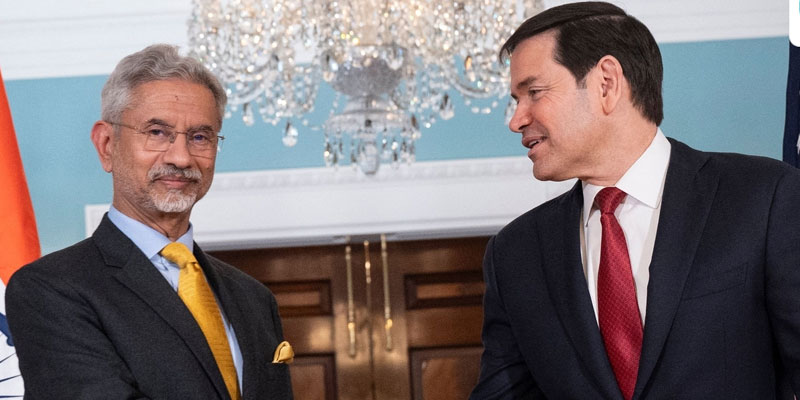
External Affairs Minister S. Jaishankar’s meeting with US Secretary of State Marco Rubio in Washington comes at a pivotal moment—just days after India and the United States concluded a landmark trade agreement that sharply reduced US tariffs on Indian exports. The timing is deliberate. Rather than a routine diplomatic engagement, the interaction serves as the first high-level strategic review after the deal, aimed at ensuring that the economic breakthrough feeds directly into longer-term geopolitical and security cooperation between the two partners.
Beyond Tariffs: Framing the Strategic Conversation
According to official readouts, Jaishankar and Rubio undertook a comprehensive review of the India–US Comprehensive Global Strategic Partnership. While trade implementation formed the immediate backdrop, the discussions clearly went well beyond customs schedules or market access. The tariff reset—from punitive effective rates that had climbed close to 50 per cent down to 18 per cent—was treated as a foundation, not an end in itself. Both sides sought to embed the agreement within a broader framework that links economic openness with strategic alignment.
Technology cooperation featured prominently, particularly under the Initiative on Critical and Emerging Technologies (iCET). Semiconductors, artificial intelligence, and digital public infrastructure were discussed as strategic enablers that reduce dependence on rival ecosystems. Defence and security issues in the Indo-Pacific also occupied central space, with emphasis on maritime domain awareness, defence co-production, and intelligence sharing—areas increasingly critical as China’s regional posture grows more assertive.
Indo-Pacific Implications: Strategy Meets Economics
The Jaishankar–Rubio talks reinforce a key US and Indian assumption: that economic and security policies in the Indo-Pacific are now inseparable. By explicitly linking trade normalization with cooperation in defence, technology, and supply chains, Washington signals that India’s economic integration into US markets is part of a larger balancing strategy in Asia, not a transactional concession.
Quad cooperation emerged as a major subtext. The reaffirmation of a “free, open, and prosperous Indo-Pacific” underscores continuity in US regional strategy, despite past trade frictions. The message is that India’s role as a net security provider—especially in the Indian Ocean and key maritime chokepoints—gains credibility when backed by deeper economic and technological ties with the United States and its allies.
Another major implication lies in critical minerals and energy security. With Rubio preparing to convene a ministerial focused on non-Chinese supply chains, India is positioning itself as a processing and manufacturing hub for lithium, cobalt, and rare earths. This has direct strategic value: diversifying away from China’s near-dominance in these materials strengthens resilience in electric vehicle, renewable energy, and defence production ecosystems across the Indo-Pacific.
The Treasury Dimension: Making the Deal Stick
Jaishankar’s parallel engagement with Treasury Secretary Scott Bessent complemented the strategic dialogue by addressing implementation mechanics. Discussions focused on smoothing customs procedures, resolving sector-specific bottlenecks, and ensuring early gains for Indian exporters in pharmaceuticals, textiles, engineering goods, and services. Equally important was the push to channel US investment into Indian manufacturing, green energy, and infrastructure—signalling a preference for long-term capital over volatile portfolio flows.
From Truce to Transformation
Taken together, the Jaishankar–Rubio talks represent a deliberate effort to convert a politically driven trade détente into a durable strategic upgrade. For India, the objective is to lock in tariff relief, tie economic access to Indo-Pacific strategy, and create fiscal and industrial space at home for defence modernisation and energy transition. For the United States, India emerges more clearly as a central pillar in an Indo-Pacific architecture that blends market access, technology collaboration, and security coordination. The real test now lies in execution—but the strategic direction is unmistakable.
(With agency inputs)