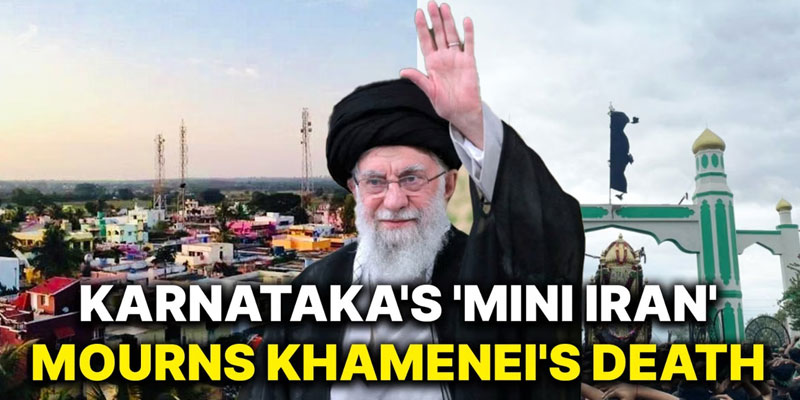
The killing of Iran’s Supreme Leader Ayatollah Ali Khamenei in US–Israel strikes has triggered waves of mourning across parts of India, most visibly in Kashmir and in pockets with strong Shia presence. In Srinagar, the iconic Lal Chowk was sealed and inter-district movement restricted following large but peaceful demonstrations on March 1. Similar expressions of grief were reported from Karnataka’s Alipura village—often called “Mini Iran”—underscoring the emotional resonance of events unfolding thousands of miles away.
Kashmir Protests: Mourning Turns into Mass Mobilisation
Sunday witnessed massive gatherings across the Valley—Srinagar, Baramulla, Anantnag, and Shopian—with Lal Chowk emerging as the epicenter. Thousands assembled to mourn Khamenei, waving Iranian flags and condemning the strikes. Demonstrations near the UNMOGIP headquarters drew particular attention. Women and children participated in chest-beating processions, reflecting deep religious symbolism.
Despite the scale of mobilization, authorities reported no violence. Security forces, including the CRPF and local police, maintained a heavy presence under the supervision of DGP Nalin Prabhat. Religious groups and the PDP, led by Mehbooba Mufti, supported a shutdown call for Monday, amplifying the political undertones.
Security Clampdown: Preventive or Excessive?
Following a high-level security review Sunday evening, the administration imposed precautionary measures. Lal Chowk was sealed, inter-district travel curtailed through checkpoints, and mobile internet services throttled. Schools and colleges were closed for two days. While mourning at Imam Bara sites was permitted, public assemblies were barred.
Officials framed the restrictions as preventive, citing concerns over potential spillover or escalation reminiscent of 2019’s unrest. Chief Minister Omar Abdullah urged calm and coordinated with the Ministry of External Affairs regarding around 100 J&K students currently in Iran.
However, Valley leaders criticized the response. Srinagar MP Aga Syed Ruhullah Mehdi called the sealing of Lal Chowk “shameful,” while National Conference spokesperson Tanvir Sadiq termed the curbs unwarranted amid peaceful protests. Peoples Conference chief Sajad Lone and former mayor Junaid Azim Mattu echoed concerns that restrictions deepened alienation.
Alipura: Karnataka’s ‘Mini Iran’ Mourns
Far from Kashmir, Alipura village in Karnataka’s Chikkaballapur district also entered three days of mourning. With over 70% of its 5,000 residents identifying as Shia, Alipura has long maintained cultural ties with Iran. The village hosts an Iranian cultural center, offers Persian language classes, and stages grand Muharram processions. Khamenei’s 1986 visit cemented its symbolic bond; Iranian flags and streets named after Persian poets reflect that connection.
After news of his death, black flags were hoisted, celebrations suspended, and special prayers held at the Imam Bara. Peaceful marches raised anti-US and anti-Israel slogans, monitored by authorities but allowed to proceed.
A Wider Ripple: Solidarity Beyond Regions
Similar protests were reported in Lucknow near the Bara Imambara, as well as in Bhopal, Ludhiana, and Ajmer—highlighting the broader Shia solidarity across India’s estimated 40–50 million Shias. The demonstrations reveal Iran’s enduring soft power, even amid diplomatic sensitivities between New Delhi and Tehran.
Balancing Security and Sentiment
The developments in Kashmir and Alipura illustrate how global geopolitical shocks can reverberate domestically through religious and cultural networks. While authorities emphasize preventive security, critics argue that excessive curbs risk deepening mistrust. With the protests largely peaceful, tensions may ease after the traditional 40-day mourning period—unless the Iran–Israel conflict intensifies. For India, the challenge lies in safeguarding public order while respecting the emotional and religious expressions of its diverse communities.
(With agency inputs)