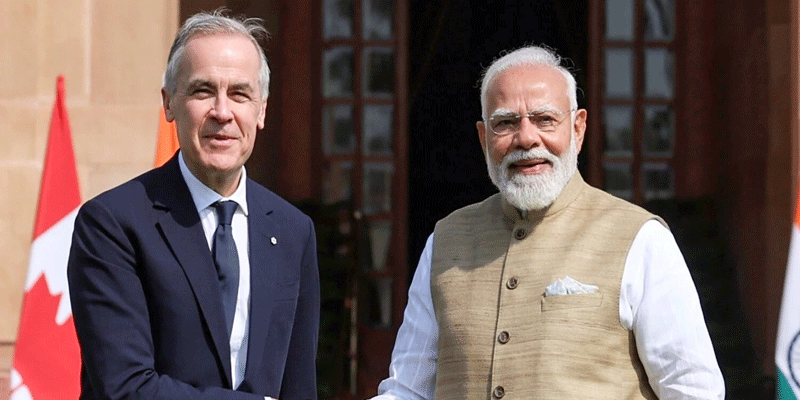
Prime Minister Narendra Modi’s expected visit to Canada in December comes as New Delhi and Ottawa seek to rebuild economic ties and accelerate negotiations for a Comprehensive Economic Partnership Agreement (CEPA). Canadian Prime Minister Mark Carney has confirmed that Modi is expected to visit Canada, while both sides are targeting completion of the trade negotiations by the end of 2026.
From Diplomatic Strain to Economic Engagement
India-Canada relations deteriorated sharply after 2023 amid serious diplomatic differences. However, economic engagement began recovering in 2026, particularly after Carney’s February 27–March 2 visit to India—the first bilateral visit by a Canadian prime minister since 2018. The two countries subsequently revived high-level engagement and formally launched CEPA negotiations.
The fourth round of CEPA negotiations concluded in September, with both sides seeking to narrow remaining differences. The next round is scheduled to begin on October 5, adding momentum to the year-end target.
What the India-Canada Trade Deal Covers
CEPA is intended to go considerably beyond conventional tariff reductions. Negotiations cover trade in goods and services, investment, market access and other rules governing bilateral commerce.
The economic stakes are substantial. Canada says two-way goods and services trade reached C$30.4 billion in 2025, while merchandise trade stood at C$13.6 billion. Ottawa and New Delhi have set an ambition to increase bilateral trade to C$70 billion annually by 2030.
Key areas of potential opportunity include:
· For Canada: greater access to India’s expanding markets for energy, minerals, agricultural products, fertilisers, education and financial services.
· For India: improved opportunities for pharmaceuticals, machinery, engineering goods, textiles, precious stones, professional services and technology.
· Energy and minerals: LNG, uranium, LPG and critical minerals are emerging as strategic pillars of the relationship.
· Investment: Indian companies are exploring opportunities in Canadian critical-mineral projects, while Canadian businesses are seeking greater access to India’s growing economy.
A C$2.6-billion uranium supply agreement between Cameco and India’s Department of Atomic Energy, alongside cooperation on critical minerals, demonstrates how trade discussions are increasingly connected with long-term supply-chain security.
What the Deal Could Mean for India
For India, a successful CEPA could diversify sources of energy, fertilisers and critical minerals while expanding export opportunities for Indian manufacturers and service providers. Greater Canadian investment could also support technology, clean energy, infrastructure and advanced manufacturing.
However, sensitive issues remain. Agriculture and dairy market access, tariff concessions, services, professional mobility and investment rules could still complicate the negotiations. Canada is also seeking expanded commercial access, while India is likely to focus on reciprocal opportunities and predictable mobility arrangements.
A Trade Pact Could Anchor the Broader Reset
A December Modi-Carney meeting could provide an important political deadline for negotiators, although the final agreement will depend on resolving outstanding technical and commercial issues.
If successfully concluded, CEPA could become the economic foundation of a broader India-Canada reset, linking trade with energy security, critical minerals, technology, investment and people-to-people ties. The real significance, therefore, lies not merely in higher trade volumes, but in whether both countries can convert renewed diplomatic engagement into a stable and long-term economic partnership.
(With agency inputs)