Millions Pledge Sacrifice as Iran Faces Ultimatum
As tensions surge ahead of Donald Trump’s looming deadline on reopening the Strait of Hormuz, Iran has unveiled a striking and controversial strategy: mass mobilisation. President Masoud Pezeshkian has declared that over 14 million Iranians are ready to “sacrifice their lives,” framing the standoff as an existential battle and signalling defiance in the face of escalating US threats.
Mass Volunteering and the Shadow of Child Recruitment
Iranian authorities claim millions have volunteered for both combat and support roles, echoing the mass mobilisation seen during the Iran–Iraq War. Reports suggest that the Islamic Revolutionary Guard Corps and affiliated groups are even recruiting children as young as 12, raising grave concerns under international humanitarian law.
This approach underscores Tehran’s belief that sheer manpower and societal resolve could offset technological disadvantages if the conflict intensifies. However, the inclusion of minors transforms the strategy into a deeply contentious issue, potentially exposing Iran to global condemnation and legal scrutiny.
Human Chains as Strategic Deterrence
In a dramatic move, Iranian officials have called on civilians—including students, athletes, and professionals—to form human chains around critical infrastructure such as power plants and bridges. These actions are intended to serve as both symbolic resistance and a physical deterrent against US strikes.
From Iran’s perspective, placing civilians around potential targets raises the political and moral cost of any attack. Yet, from a legal and ethical standpoint, it blurs the line between protection and exploitation, effectively positioning civilians as human shields in a high-risk environment.
Trump’s Escalation: A Four-Hour Threat
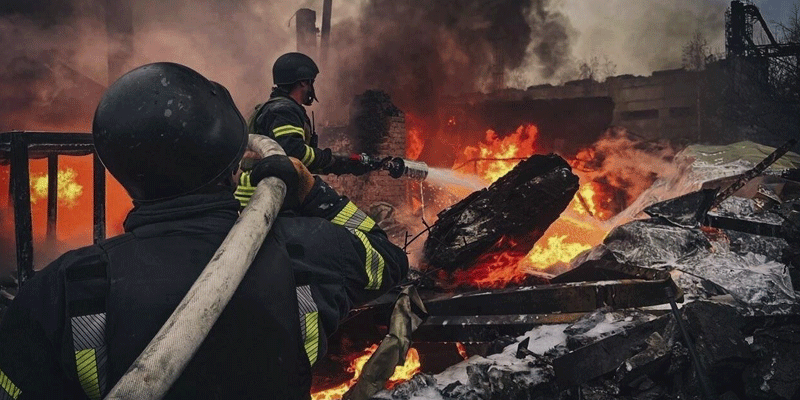
Trump has matched Iran’s defiance with stark warnings. He has linked his deadline directly to a potential large-scale strike campaign, threatening to cripple Iran’s infrastructure within hours if demands are not met. His statements about leaving power plants and bridges “burning” suggest a strategy aimed at paralyzing the country’s energy and transport systems.
Analysts warn that such an operation could involve advanced munitions designed to disable infrastructure without immediate mass casualties but with severe long-term humanitarian consequences. The risk of widespread blackouts, economic collapse, and civilian suffering looms large.
Strategic Logic and Escalation Risks
Iran’s mobilisation strategy operates at the intersection of deterrence and propaganda. By showcasing mass civilian willingness to endure hardship, Tehran aims to project resilience and complicate US decision-making. Domestically, the narrative of sacrifice seeks to unify the population and reinforce legitimacy amid internal and external pressures.
However, this approach carries immense risks. Human chains and civilian presence near strategic sites will not physically prevent precision strikes. Instead, they increase the likelihood of high civilian casualties if attacks occur—potentially turning infrastructure strikes into humanitarian disasters.
For the United States, the message is equally uncompromising: civilian mobilisation will not shield Iran’s assets if strategic objectives are unmet. This creates a dangerous cycle of brinkmanship, where both sides escalate rhetoric and actions with diminishing room for de-escalation.
A Dangerous Game of Resolve
The current standoff reflects a classic escalation spiral, with maximalist threats met by maximalist defiance. Iran’s mobilisation signals readiness to absorb immense costs, while the US signals willingness to impose them. At the heart of this confrontation lies a critical question: will diplomacy intervene before irreversible damage is done?
As the deadline approaches, uncertainty remains over whether Trump will extend the timeline once again or act on his threats. What is clear, however, is that ordinary civilians now stand at the frontlines of a geopolitical gamble—one where the stakes are not just strategic, but profoundly human.
(With agency inputs)