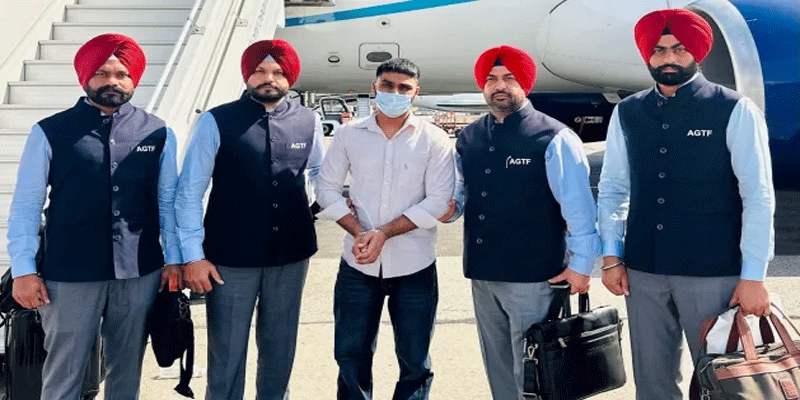
Punjab Police has brought alleged gangster Amritpal Singh, alias Amrit Dalam and Gurpal Singh, back to India from Moldova after a six-month international operation. His extradition, completed on September 11, marks what the state police describes as its first successful extradition of a wanted criminal from a European country, highlighting a more aggressive approach towards organised crime networks operating beyond India’s borders.
A Wanted Criminal with Multiple Cases
Singh faces 21 criminal cases across Punjab, involving allegations ranging from murder and attempted murder to extortion, weapons smuggling, narcotics offences and violations of the Unlawful Activities (Prevention) Act and Arms Act. Police records include five murder cases, nine Arms Act cases, an NDPS case and a UAPA-and-explosives case.
Four cases are already at the trial stage in Batala, while investigations continue into 17 others across Batala, Gurdaspur, Amritsar, Hoshiarpur and Ludhiana. The allegations remain subject to judicial proceedings, and Singh is entitled to due process.
Alleged Gang Connections and Flight Abroad
Investigators have identified Singh as an alleged key operative and main hitman of the Jaggu Bhagwanpuria gang, with alleged links to foreign-based gangster Harry Chattha. Police have connected him with targeted killings, extortion and illegal weapons movement.
Among the cases under investigation are the alleged killings of Kashmiri Lal and his son Amarjit Singh in Hoshiarpur and the murder of gangster Gurpreet Singh, alias Gora Bariar. Investigators also cited a double-murder case registered at Bullowal police station in October 2024, which became part of the international extradition process.
Police allege that Singh fled India in October 2024 using a forged passport carrying the particulars of a Haryana resident named Gurpal Singh. His reported route took him through the UAE and Turkey before he reached eastern Europe.
The international pursuit intensified when Moldovan authorities arrested Singh on February 24, 2026, near the Otaci state border while he was allegedly attempting to cross towards Ukraine.
Punjab Police and central agencies subsequently shared his identity, travel history and forged passport details with international authorities, leading to an Interpol Red Corner Notice. The legal process culminated when the Court of Chisinau approved extradition on May 26.
Singh challenged the decision, but Moldova’s Court of Appeal Centru rejected his appeal on July 16. A four-member Punjab Police team led by Superintendent of Police Bikramjit Singh Brar then travelled to Moldova to complete the handover and escort him to India through Baku, Azerbaijan.
The operation involved the Anti-Gangster Task Force and Overseas Fugitive Tracking and Extradition Cell, working with the CBI’s International Police Cooperation Unit, the Ministries of Home and External Affairs, and Moldovan and Azerbaijani authorities.
A New Front in Punjab’s Crime Fight
The case illustrates how organised-crime networks increasingly exploit international borders, forged identities and overseas transit routes. Punjab Police said its extradition mechanism has already helped return nine high-priority fugitives, while 11 other overseas cases remain under pursuit.
Singh’s return could provide investigators an opportunity to examine alleged links between gang violence, narcotics trafficking, weapons networks and overseas financing.
Extradition Is Only the Beginning
Bringing a fugitive home is a significant policing achievement, but the ultimate test lies ahead. Investigators must build admissible evidence, complete charge sheets and secure convictions through due process. The success of Punjab’s transnational crime strategy will ultimately be measured not by how many fugitives it brings back, but by how effectively the justice system turns international operations into courtroom outcomes.
(With agency inputs)