US Strikes on Tankers Put Indian Crew at Risk
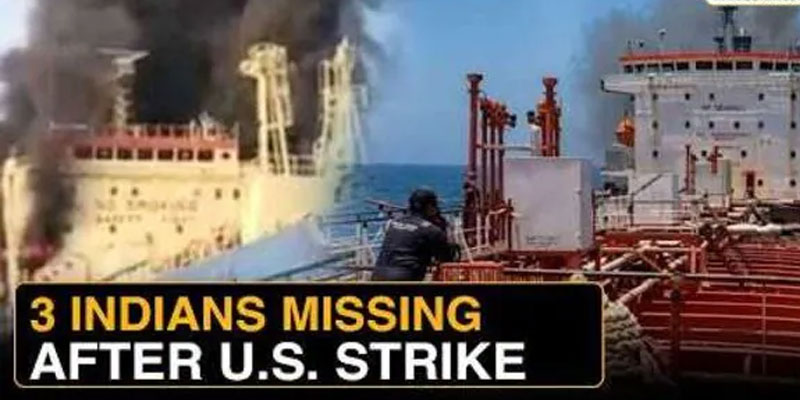
Two attacks in three days on oil tankers carrying Indian crew members have sharply exposed the growing dangers facing commercial shipping in the Gulf of Oman. The incidents, involving the vessels Marivex and Settebello, have also intensified diplomatic tensions after the United States formally acknowledged responsibility for both strikes carried out under its naval blockade against Iran. While all 24 Indian crew members aboard Marivex were rescued safely, three Indian nationals from Settebello remain missing, prompting India to summon a senior American diplomat and seek urgent clarity over the attacks.
Twin Attacks Raise Maritime Alarm
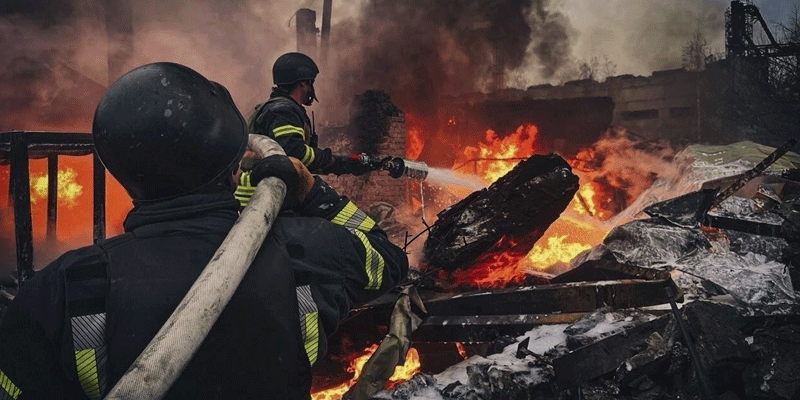
The first incident occurred on June 8, when the Palau-flagged oil tanker Marivex, carrying 24 Indian crew members, came under attack near the Strait of Hormuz. According to the US Central Command (CENTCOM), an F/A-18 Super Hornet launched from the USS Abraham Lincoln carried out a precision strike targeting the vessel’s engineering and steering systems after it allegedly violated the American blockade of Iranian ports.
A day later, another Palau-flagged tanker, Settebello, also carrying 24 Indian crew members and transporting Iranian oil, was struck in a similar manner. CENTCOM stated that the vessel was disabled after crew members repeatedly failed to comply with US instructions. While 21 crew members were rescued through coordinated operations involving Omani authorities, three Indian mariners remain unaccounted for.
Both vessels were operating in waters close to the Strait of Hormuz, one of the world’s most strategically sensitive maritime corridors through which nearly one-fifth of global oil supplies transit every day.
The US-Iran Conflict Behind the Crisis
The attacks are directly linked to the United States’ naval blockade on Iran, imposed on April 13, 2026, amid escalating hostilities between Washington and Tehran. The blockade aims to pressure Iran into negotiations over the ongoing conflict that began earlier this year. Since then, CENTCOM has reportedly redirected dozens of commercial ships and boarded several vessels suspected of transporting Iranian cargo.
Maritime security agencies, including British firm Ambrey, have indicated that the strikes on Marivex and Settebello were likely part of US efforts to prevent oil shipments reaching Iranian ports. The incidents reflect the increasingly militarised environment in the Gulf region, where commercial shipping is becoming entangled in broader geopolitical confrontations.
India’s Diplomatic and Strategic Concerns
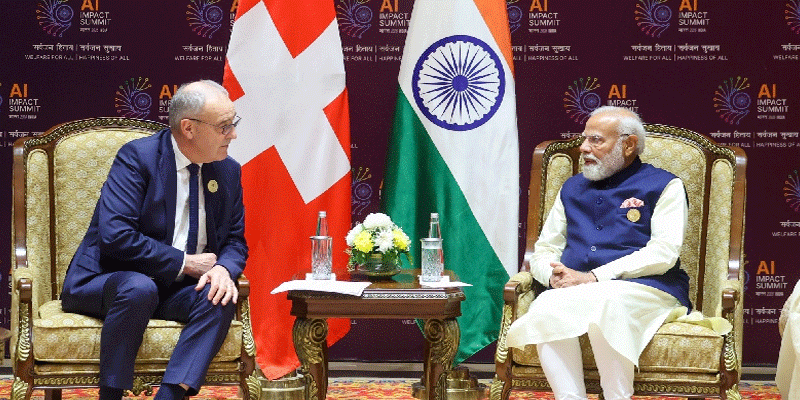
India’s Ministry of External Affairs condemned the attack on Settebello and confirmed that Indian officials were coordinating closely with Omani authorities on rescue efforts. Although New Delhi’s initial statement avoided directly naming the United States, the decision to summon a senior American diplomat signalled serious concern over the safety of Indian nationals.
The developments also underline a larger strategic dilemma for India. Iran remains an important energy partner, while the United States is one of India’s key strategic allies. With nearly 200,000 Indian seafarers employed globally, many of them working on oil tankers in West Asian waters, such incidents place Indian citizens directly in the path of geopolitical rivalries.
Navigating Dangerous Waters
The attacks on Marivex and Settebello reveal how rapidly escalating global conflicts can endanger civilian maritime operations and innocent crew members. For India, the challenge extends beyond diplomacy to ensuring the safety of its seafarers in increasingly volatile shipping lanes. As tensions between the United States and Iran deepen, the Gulf region risks becoming an even more dangerous arena where commerce, energy security, and geopolitics collide.
(With agency inputs)