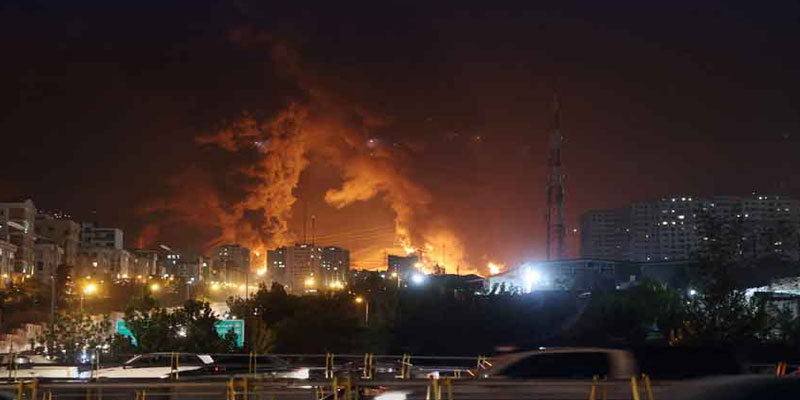
Tensions across the Gulf intensified dramatically on June 5 after the United States launched strikes on Iranian radar installations in response to drone attacks targeting maritime traffic in the Persian Strait. The United States Central Command confirmed that multiple drones heading toward commercial shipping routes were intercepted before American forces carried out retaliatory operations against Iranian military infrastructure. Simultaneously, Kuwait’s air defence systems reportedly intercepted missile and drone attacks aimed at sensitive regional locations, raising fears of a wider regional confrontation.
Months of Growing Regional Conflict
The latest escalation is part of a broader conflict involving the United States, Israel, and Iran that has steadily intensified since early 2026. Over recent months, Iran and allied groups have repeatedly targeted American military positions across the Gulf. Satellite imagery and defence assessments indicate that at least 20 U.S. military facilities in the region have sustained varying levels of damage since hostilities began.
Earlier in February, two suspected Iranian drones struck the U.S. Embassy compound in Riyadh, causing limited fire damage and heightening concerns over the expanding scope of the conflict. Iran’s Islamic Revolutionary Guard Corps has also been linked to ballistic missile strikes on key American positions, including the Ali Al-Salam Air Base in Kuwait, which Tehran described as retaliation for previous U.S. air operations.
U.S. Response and Conflicting Missile Assessments
According to U.S. Central Command, American forces successfully intercepted several drones before they could threaten maritime traffic in the Persian Strait, one of the world’s most strategically vital shipping corridors. The subsequent strikes on Iranian radar facilities were intended to disrupt Tehran’s surveillance and targeting capabilities.
Amid the escalating conflict, Donald Trump stated in an interview with NBC News that Iran now retains only “21–22 percent” of its original missile stockpile. However, independent intelligence assessments have contradicted that claim, suggesting Tehran still possesses nearly 70 percent of its pre-war missile inventory, including long-range ballistic missiles and mobile launch systems.
The conflicting narratives have fueled uncertainty over the actual extent of Iran’s military degradation. While Washington insists its operations have significantly weakened Tehran’s offensive capabilities, analysts argue Iran still retains enough strategic assets to sustain prolonged asymmetric warfare.
Lebanon Remains Central to Ceasefire Deadlock
Another major obstacle to de-escalation remains the conflict surrounding Hezbollah in southern Lebanon. Iran has formally demanded Israel’s full withdrawal from Lebanese territory as a condition for any broader regional ceasefire agreement.
Hezbollah, backed by Tehran, has rejected a ceasefire renewal negotiated by Israeli and Lebanese officials in Washington. Hezbollah leader Naim Qassem declared that resistance operations would continue as long as Israeli military presence remained in disputed areas.
A Region Facing Dangerous Uncertainty
The latest military exchanges underline the fragile state of security across the Gulf and the wider Middle East. U.S. strikes on Iranian territory, persistent drone and missile attacks, and the unresolved Lebanon dispute have pushed the region closer to broader confrontation. With competing military claims, stalled diplomacy, and rising geopolitical stakes, prospects for lasting stability remain uncertain as global powers closely monitor the rapidly evolving crisis.
(With agency inputs)