Hundreds Rally at Jantar Mantar
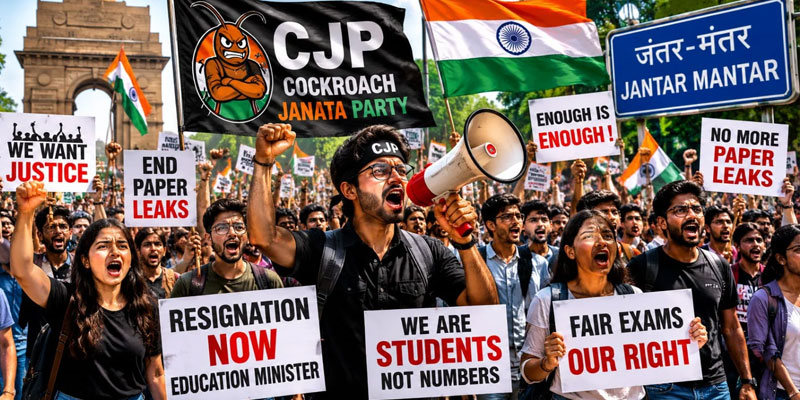
Hundreds of protesters gathered at Delhi’s Jantar Mantar on June 6 as the Cockroach Janta Party (CJP) intensified its demand for Union Education Minister Dharmendra Pradhan to resign over alleged irregularities in national examinations. Led by activist and founder Abhijeet Dipke, the demonstration drew students, aspirants, and youth groups who accused the education system of failing millions through repeated lapses in transparency and accountability.
Rise of the Cockroach Janta Party
The Cockroach Janta Party, popularly known as CJP, emerged as a youth-driven online movement rooted in constitutional protest and anti-corruption messaging. Its unusual name was deliberately chosen to symbolize resilience and persistence against what supporters describe as a deeply flawed examination ecosystem. Through aggressive social media outreach and student mobilization campaigns, Dipke transformed scattered grievances into a coordinated protest movement.
The slogan, “Cockroaches aa rahe hain, Dharmendra Pradhan jaa rahe hain,” has become the defining chant of the campaign, portraying the agitation as an attempt to “cleanse” the system of institutional negligence. Though critics question the symbolism and methods, the movement has steadily gained traction among students frustrated by repeated examination controversies.
Why Students Are Protesting
At the center of the agitation are allegations of irregularities in several major examinations. Protesters pointed to the controversy surrounding National Testing Agency-conducted NEET examinations, where alleged paper leaks and administrative failures reportedly affected thousands of medical aspirants.
The CJP also raised concerns over alleged standardization and manual marking issues in Central Board of Secondary Education examinations, popularly referred to as the “OSM row.” Similar accusations were directed at the Common University Entrance Test and recruitment examinations conducted by the Staff Selection Commission.
According to organizers, “lakhs of students” have suffered because of poor oversight and inadequate safeguards. The protest has also received indirect momentum from parallel campaigns by the National Students' Union of India, which has repeatedly demanded accountability over alleged examination scams.
Security Arrangements and Latest Developments
Delhi Police granted official permission for the June 6 protest from 10 a.m. to 5 p.m., allowing participants to gather directly at Jantar Mantar. Authorities deployed nearly 40 companies of paramilitary personnel along with thousands of police officers to maintain order around the protest venue.
Senior police officials, including Joint Commissioners, DCPs, Additional DCPs, and ACPs, supervised security arrangements throughout the day. Organizers repeatedly emphasized that the protest would remain peaceful and constitutional in nature.
The demonstration also gained visibility after reports suggested noted environmentalist Sonam Wangchuk was expected to attend, adding symbolic weight to the movement.
Political and Social Impact
The protest highlights deepening public anxiety over the credibility of India’s competitive examination system. Repeated allegations involving entrance and recruitment tests have amplified distrust among students already facing intense academic and economic pressure.
While the CJP’s unconventional branding initially attracted skepticism, its ability to mobilize large numbers reflects broader frustration with institutional accountability. The growing convergence of student organizations and civil society voices may increase pressure on the government to introduce stricter transparency measures before upcoming examination cycles.
Beyond Protest: The Push for Systemic Reform
The June 6 demonstration at Jantar Mantar represents more than a political protest; it reflects a widening crisis of confidence in India’s examination framework. Whether or not the demand for Dharmendra Pradhan’s resignation gains political traction, the agitation has amplified a national conversation on fairness, transparency, and student welfare. As examination reforms become an increasingly urgent public issue, the government’s response in the coming months could significantly shape trust in the country’s education system.
(With agency inputs)