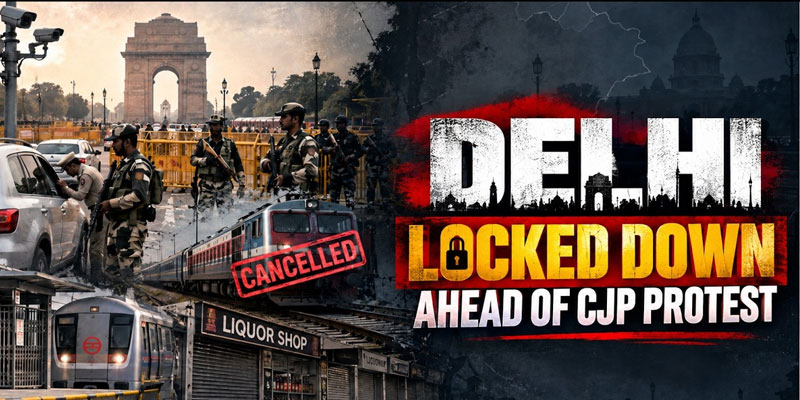
The proposed June 6 protest by the Cockroach Janata Party at Jantar Mantar has triggered a wider debate over protest rights, legal permissions and public dissent in the national capital. The controversy intensified after party spokesperson Saurav Das stated that the organisation would proceed with the protest even if the Delhi Police refused permission. The planned demonstration, centred around demands including the resignation of Union Education Minister Dharmendra Pradhan, has now become a test case involving both procedural legality and political messaging.
Background: Why Jantar Mantar Matters
Jantar Mantar has long functioned as one of India’s most recognised spaces for organised public protests and demonstrations. Over the years, activists, political parties, student organisations and civil society groups have used the location to raise issues ranging from corruption and unemployment to social justice and education reforms.
However, protests at the site are governed by strict administrative procedures. Under existing Delhi Police guidelines, organisers must obtain written permission at least seven days before the proposed event. Authorities typically examine crowd size, security arrangements, law-and-order concerns and logistical management before granting approval.
The rules are intended to balance democratic rights with public order, especially in sensitive areas near Parliament and central government institutions.
What The Cockroach Janata Party Is Planning
The Cockroach Janata Party has openly acknowledged that it did not apply within the mandatory timeline. According to party representatives, this was not an oversight but a deliberate symbolic act protesting what they describe as excessive administrative control over public dissent.
Saurav Das said the group planned to arrive in Delhi on June 6, visit the Parliament Street police station that morning and then proceed toward Jantar Mantar for a peaceful demonstration. Despite the procedural violation, he expressed confidence that police authorities would eventually permit the protest.
At the same time, Das questioned the necessity of prior permission itself, arguing that publicly announcing the protest and conducting press conferences should have already alerted authorities sufficiently.
The Legal Position and Possible Consequences
Legally, the situation remains clear. Under current regulations, conducting a protest at Jantar Mantar without prior approval would technically amount to a violation of public assembly rules. Delhi Police had reportedly not granted permission as of June 4, and officials generally reject applications that fail to comply with procedural timelines.
If the protest proceeds without authorisation, police could disperse the gathering, detain organisers or initiate legal proceedings under relevant sections related to unlawful assembly and public order management.
Legal experts note, however, that India’s constitutional framework also guarantees the right to peaceful protest under Article 19, creating a recurring tension between civil liberties and administrative regulation. Courts have repeatedly held that while the right to protest exists, it remains subject to reasonable restrictions in the interest of public order and security.
Growing Public Attention and Political Messaging
The controversy has rapidly gained traction on social media, where reactions remain sharply divided. Supporters view the CJP’s stance as a symbolic challenge against bureaucratic restrictions on democratic expression, while critics argue that openly defying legal procedures undermines the rule of law.
The uncertainty surrounding police action, possible detentions and crowd management has now made the June 6 protest politically significant beyond its original demands.
Protest Rights Versus Procedural Law
The Cockroach Janata Party’s planned demonstration highlights the continuing debate over how democratic protest should function in modern India. While peaceful dissent remains a constitutional right, authorities insist that procedural safeguards are essential for maintaining order in sensitive public spaces. The outcome of the June 6 protest may therefore shape not only immediate legal responses but also broader conversations about the balance between civil liberties and state regulation in democratic protest movements.
(With agency inputs)