Normal Supplies Resume as West Asia Pressures Recede
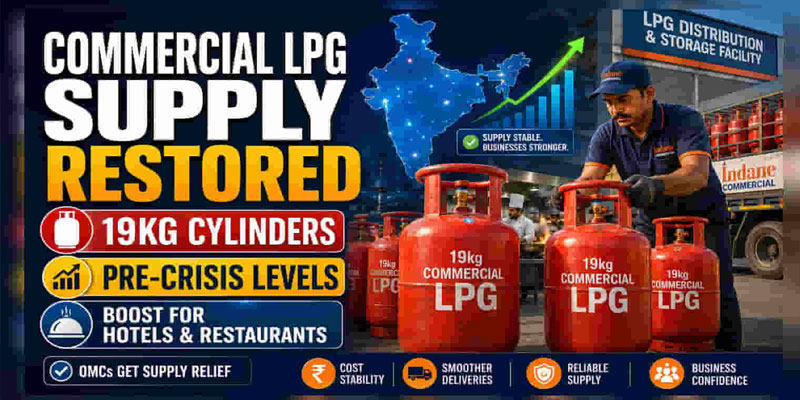
The Centre has restored commercial Liquefied Petroleum Gas (LPG) supplies to pre-West Asia crisis levels, withdrawing restrictions that had been imposed during the recent geopolitical tensions in the region. The move comes as domestic production has improved and imported LPG cargoes have become more readily available, allowing the government to normalise supplies for commercial consumers while continuing to safeguard household requirements. The decision is expected to provide significant relief to hotels, restaurants, caterers, and other businesses that depend heavily on commercial LPG for their daily operations.
Why Were the Restrictions Introduced?
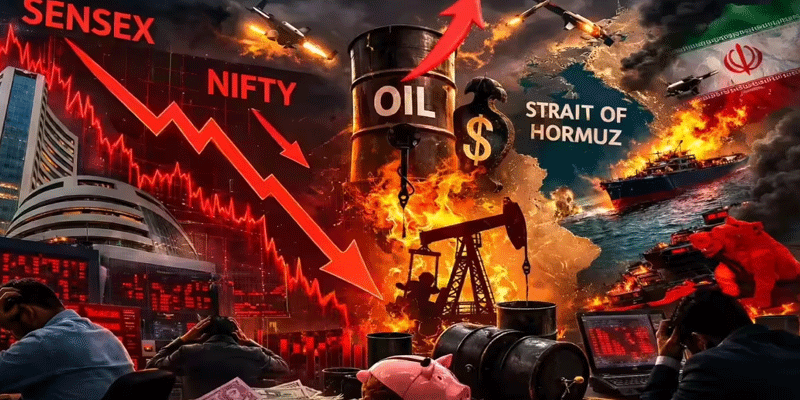
The restrictions were introduced as a precautionary measure when the conflict in West Asia disrupted global energy markets and raised concerns over the availability of imported LPG. India imports a substantial portion of its LPG requirements, making it vulnerable to supply disruptions arising from geopolitical tensions, particularly around critical shipping routes such as the Strait of Hormuz.
To prevent any shortage of cooking gas for households, the government temporarily diverted available supplies toward domestic consumers while limiting allocations to commercial users. This ensured uninterrupted access to LPG cylinders for millions of households across the country even as global supply chains came under pressure.
During the peak of the crisis, commercial users experienced tighter supplies, while bulk LPG consumption was also curtailed as part of the government's broader demand management strategy.
Improved Supply Situation Enables Policy Reversal
The easing of restrictions reflects a significant improvement in India's fuel supply situation. Higher domestic LPG production, coupled with better availability of imported cargoes, has strengthened inventories and reduced concerns over shortages. Alongside restoring commercial packed LPG supplies to normal levels, the government has also partially resumed bulk LPG supplies at around 50 per cent of pre-crisis consumption.
The Petroleum Ministry's decision signals confidence that immediate supply risks have subsided. Importantly, throughout the crisis, authorities maintained that household LPG distribution remained uninterrupted, with no reports of dry-outs at distributorships despite the temporary rationing of commercial supplies.
Balancing Energy Security and Industry Needs
The episode highlights the delicate balancing act India must perform between ensuring household energy security and supporting commercial activity. During periods of international supply disruption, protecting domestic cooking fuel naturally becomes the government's first priority. However, prolonged restrictions on commercial LPG can significantly affect restaurants, hotels, food processors, catering services, and several small industries, leading to higher operating costs and supply uncertainty.
By restoring commercial supplies promptly once conditions improved, the government has sought to strike a balance between social welfare and economic activity. The move also demonstrates the importance of maintaining flexible policy responses that can adapt quickly to changing global circumstances.
At the same time, the crisis has reinforced the need to strengthen India's long-term energy resilience through greater domestic production, diversified import sources, expanded storage capacity, and more robust supply-chain management to reduce dependence on any single region.
A Positive Signal, But A Reminder for the Future
The restoration of commercial LPG supplies is more than a routine policy adjustment—it signals that the immediate supply stress triggered by the West Asia crisis has largely eased. For businesses, it offers operational certainty, stabilises fuel availability, and helps contain cost pressures across the hospitality and food-service sectors. At a broader level, the episode underscores both the resilience of India's energy management framework and the continuing need to build stronger safeguards against future geopolitical disruptions. As global energy markets remain unpredictable, enhancing energy security will remain essential to protecting both consumers and economic growth.
(With agency inputs)