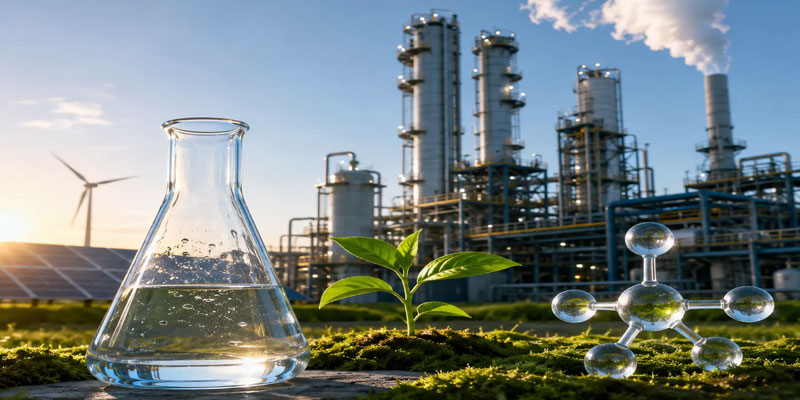
Adani Group has partnered with French climate technology company Dioxycle to develop low-carbon chemicals in India, marking an important step in the country's industrial decarbonisation journey. The collaboration will begin with a pilot plant that converts captured carbon dioxide and renewable electricity into formic acid, laying the foundation for a new generation of sustainable chemical manufacturing. The initiative not only broadens Adani's clean-energy ambitions beyond renewable power but also reflects India's growing focus on reducing emissions from hard-to-abate industrial sectors through advanced technological innovation.
Expanding Decarbonisation Beyond the Power Sector
India has made significant progress in expanding renewable energy generation over the past decade. However, reducing emissions from heavy industries such as chemicals, cement and steel remains a far greater challenge because these sectors depend heavily on carbon-intensive production processes rather than electricity alone.
Against this backdrop, the Adani-Dioxycle partnership represents an important shift towards decarbonising industrial chemistry itself. The pilot project will focus on manufacturing formic acid using captured carbon dioxide and renewable electricity instead of conventional fossil-based feedstocks. Subject to successful commercial validation, the two companies also plan to explore the production of other low-carbon industrial chemicals.
Formic acid is widely used across textiles, leather processing, agriculture, pharmaceuticals, rubber manufacturing and chemical synthesis, providing the project with substantial commercial potential if production costs prove competitive.
Transforming Carbon into an Industrial Resource
The defining feature of Dioxycle's technology lies in its ability to convert carbon dioxide emissions into valuable chemical products using renewable electricity. Unlike traditional chemical manufacturing, which relies primarily on fossil-derived raw materials, this process treats captured carbon as a productive industrial input.
This represents a deeper level of decarbonisation than simply powering conventional factories with renewable energy. If successfully scaled, the technology could significantly reduce industrial carbon emissions while creating productive uses for captured CO₂ that would otherwise be released into the atmosphere.
The project also serves as an important demonstration of carbon utilisation technologies, an area that has shown considerable scientific promise but has often struggled to achieve commercial viability due to cost and scalability challenges.
Strategic Business and Economic Implications
For Adani Group, the partnership marks a strategic expansion into advanced clean manufacturing. The company has already established a diversified presence across renewable energy, ports, logistics, mining and infrastructure. Adding low-carbon chemical production complements this integrated industrial ecosystem by combining renewable power generation with value-added manufacturing.
The collaboration also positions Adani to benefit from evolving global market trends. Increasing environmental regulations, carbon pricing mechanisms and sustainability commitments from multinational companies are expected to boost demand for lower-emission industrial products. Early investments in clean manufacturing technologies could therefore provide a significant long-term competitive advantage.
From a broader perspective, the partnership also strengthens India-Europe cooperation in climate technology. European innovators contribute advanced process engineering and carbon management expertise, while India offers large-scale industrial infrastructure, growing domestic demand and competitive manufacturing capabilities. Such collaborations are likely to become increasingly important as countries pursue net-zero industrial transitions.
A Critical Test for Industrial Decarbonisation
The Adani-Dioxycle partnership represents more than a single pilot project; it is a test of whether low-carbon chemical manufacturing can become commercially viable at industrial scale. While the underlying technology has demonstrated scientific potential, its long-term success will ultimately depend on production costs, operational reliability and market competitiveness. If the project succeeds, it could establish a new model for carbon-to-chemicals manufacturing in India and accelerate industrial decarbonisation. Even if challenges emerge during commercial deployment, the initiative will provide valuable insights into one of the most complex aspects of the global transition towards a cleaner and more sustainable industrial economy.
(With agency inputs)