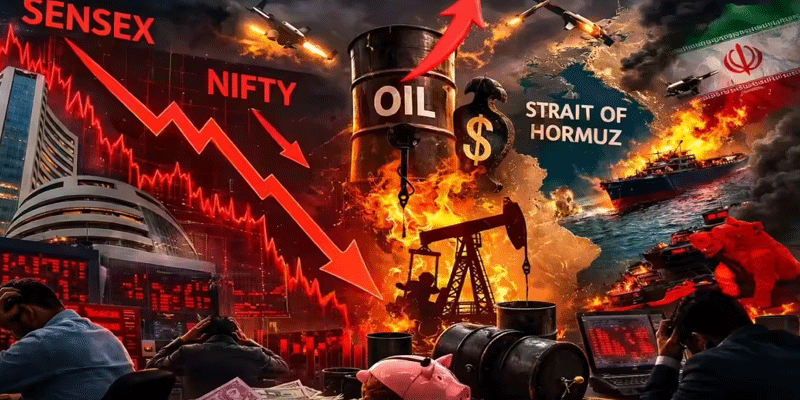
Washington’s Unyielding Pressure on Tehran
The United States has once again tightened the screws on Iran’s energy sector under its continuing “maximum economic pressure” campaign. As part of its latest enforcement action, Washington has sanctioned nine India-based companies and eight Indian nationals, accusing them of participating in Iran’s oil and petrochemical trade. The move, announced on Thursday, underscores the Trump administration’s renewed determination to choke Tehran’s revenue streams that fund what it calls Iran’s destabilizing regional activities.
This latest measure forms part of a broader network of restrictions targeting nearly 100 individuals, entities, and vessels across multiple countries, including China and the United Arab Emirates, for allegedly facilitating Iran’s petroleum exports. The sanctions signal that Washington’s economic warfare on Iran is far from over—and that its reach extends well beyond the Middle East.
The Indian Connection: Nine Companies and Eight Nationals Named
Among those affected, eight Indian trading companies and one shipping firm have been identified for their alleged roles in importing or transporting Iranian-origin petrochemicals and liquefied petroleum gas (LPG). The firms include Mumbai-based CJ Shah & Co, Chemovick, Mody Chem, Paarichem Resources, Indisol Marketing, Haresh Petrochem, Shiv Texchem, and Delhi-based BK Sales Corporation.
According to the US State Department, these companies collectively purchased hundreds of millions of dollars’ worth of Iranian petrochemicals over recent years, in violation of existing US sanctions.
In addition, five Indian businesspersons—Piyush Maganlal Javiya (Chemovick), Niti Unmesh Bhatt (Indisol Marketing), and Kamla, Kunal, and Poonam Kasat (Haresh Petrochem)—were individually designated.
The US Office of Foreign Assets Control (OFAC) also named three Indian nationals—Varun Pula, Iyappan Raja, and Soniya Shrestha— for their alleged links to vessels transporting Iranian LPG. OFAC identified Mumbai-based Vega Star Ship Management, owned by Shrestha, as the operator of the Comoros-flagged vessel Nepta, which reportedly carried Iranian LPG to Pakistan.
Pula’s Marshall Islands-based Bertha Shipping was cited for managing the Comoros-flagged Pamir, which allegedly transported four million barrels of Iranian LPG to China since mid-2024. Raja, meanwhile, was linked to Evie Lines, owner of the Panama-flagged Sapphire Gas, which shipped over a million barrels of Iranian LPG to China this year. All three vessels have now been blocked by Washington.
Washington’s Warning: Crippling Iran’s Energy Export Machine
The US Treasury Department, in its announcement, stated that all assets belonging to the sanctioned individuals and entities within US jurisdiction are now frozen, and American citizens are prohibited from engaging in transactions with them. Treasury Secretary Scott Bessent remarked that the move was part of an effort to “degrade Iran’s cash flow by dismantling key elements of its energy export machine.”
The action, he said, reflects the Trump administration’s goal of cutting off funding for terrorist organizations and proxy groups allegedly supported by Tehran. The designations also targeted two dozen “shadow fleet” vessels, a China-based crude terminal, and a refinery, all of which the US says play vital roles in Iran’s ability to export energy commodities and evade sanctions.
Iran’s Petrochemical Trade Under Scrutiny
The State Department emphasized that Iran’s petrochemical sector has become a central pillar of its economy, generating billions in revenue despite sanctions. To conceal their origin, Iranian exports are often routed through intermediaries and front companies in third countries, complicating enforcement.
“The Iranian regime continues to finance regional conflicts and nuclear ambitions through these illicit sales,” the statement said. “The United States will continue to act against networks of terminal operators, port agents, and traders who enable these flows.”
The targeting of intermediaries and smaller firms underscores Washington’s shift in focus—from large state-backed enterprises to the web of smaller entities helping Tehran bypass sanctions through covert logistics and financial networks.
Recurring Pattern: Indian Entities Under the Scanner
This is not the first time Indian firms have been caught in the crosshairs of US sanctions. In July 2024, Washington sanctioned eight Indian companies and five nationals linked to Iranian oil trade and to a shipping network allegedly tied to Mohammad Hossein Shamkhani, son of a senior Iranian political adviser.
Even before the “maximum pressure” strategy gained momentum, a handful of Indian shipping firms had been penalized for transporting Iranian oil or Russian LNG in violation of Western restrictions. Many of these entities were small or recently established, rather than major corporate players—suggesting that while India’s large energy conglomerates avoid sanctioned trades, smaller traders have occasionally engaged in high-risk deals for profit.
Strategic Implications: Balancing Policy and Pressure
The renewed sanctions carry broader geopolitical implications. For India, which maintains a delicate balance between its strategic partnership with the US and longstanding ties with Iran, the move poses both diplomatic and economic challenges. While New Delhi has largely aligned with Washington’s sanctions regime, these designations reveal loopholes exploited by smaller players, potentially inviting stricter scrutiny in the future.
For Washington, the designations serve a dual purpose: reinforcing its deterrence message to international traders and signaling to Tehran that economic isolation will persist until it curtails its nuclear and regional ambitions.
A Persistent Tug-of-War Over Energy and Influence
The sanctioning of Indian firms and individuals marks another escalation in the long-running contest between US enforcement and Iran’s circumvention tactics. As Washington continues to expand its pressure campaign, even marginal actors in global energy trade now find themselves under the radar.
For India, the development is a reminder that global compliance demands vigilance, particularly as the US extends its sanctions web deeper into Asia’s trading networks. For Iran, meanwhile, it underscores the increasingly narrow pathways through which it can sustain its vital oil and petrochemical exports.
In essence, this episode illustrates a larger truth of contemporary geopolitics — that in the struggle over energy, sanctions, and sovereignty, no player, big or small, operates outside the orbit of global power politics.
(With agency inputs)