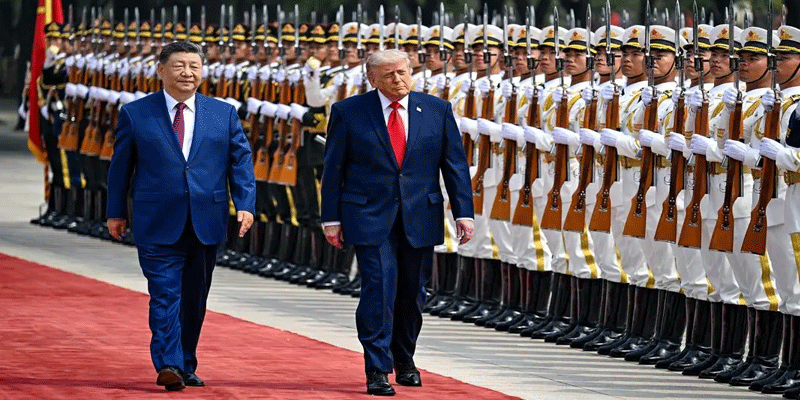
The three-day Washington visits by Chinese President Xi Jinping produced a series of understandings with US President Donald Trump, including reciprocal tariff reductions covering about $30 billion of non-sensitive goods in each direction and a formal dialogue on artificial intelligence. The outcome extends the recent effort to stabilise relations while leaving major disputes over technology, strategic competition and market access unresolved.
Targeted Tariff Relief Takes Centre Stage
The most immediate economic outcome is an agreement for more favourable tariff treatment on selected goods worth about $30 billion in each direction. The products include US agricultural goods, wood and cosmetics, while US tariff reductions would cover Chinese small appliances, toys and decorations.
The wording of the agreement is significant. Washington described the outcome as recommendations for more favourable tariff treatment, while Beijing characterised it as a reciprocal tariff-reduction arrangement and said leaders had instructed officials to implement it. This indicates that detailed tariff schedules, procedures and timelines still require follow-up.
The arrangement also deliberately focuses on non-sensitive goods, avoiding some of the most difficult disputes involving advanced semiconductors, industrial policy, strategic technology and supply-chain security.
AI Dialogue Creates a New Communication Channel
The summit's technology outcome could have longer-term importance. Washington and Beijing agreed to establish a dialogue covering the risks and benefits of artificial intelligence, with the next round scheduled for November. They will also create a communication channel for AI-related incidents.
Such a mechanism could provide a direct channel when an advanced AI system malfunctions or an incident involving emerging technology creates diplomatic tensions. However, it does not represent an arms-control agreement or eliminate competition over chips, computing capacity, data and military applications.
Trade Truce Extended, Economic Channels Expanded
The two sides also agreed to extend the outcomes of earlier Kuala Lumpur negotiations and establish a trade council. The broader objective is to keep officials engaged rather than allowing disagreements to escalate without direct communication.
The summit additionally produced understandings on continued military crisis communication and cooperation around international forums. Both leaders are expected to support each other's hosting of major Asia-Pacific Economic Cooperation and G20 meetings.
Why The Agreement Matters
The outcome follows a period of tariffs and retaliatory measures that disrupted trade and complicated supply chains. The latest package provides businesses dealing in covered products with greater clarity while reducing the immediate possibility of another tariff escalation.
For American farmers, improved access to the Chinese market is particularly relevant because agricultural products have previously been affected by trade retaliation. For Chinese exporters, lower US duties on selected consumer goods could reduce costs and support trade in relatively less strategic sectors.
A Tactical Thaw, Not A Complete Trade Reset
The summit has produced practical mechanisms for managing competition, but it has not removed the fundamental differences between Washington and Beijing. The limited product coverage, unresolved technology restrictions and continuing strategic rivalry show that the latest understandings are designed primarily to manage tensions and preserve dialogue.
The real significance of the Xi-Trump summit will therefore depend on implementation. If tariff commitments are converted into concrete measures and the new AI and trade channels operate regularly, the agreements could provide greater stability. For now, however, the summit represents a structured effort to keep competition from escalating into uncontrolled confrontation rather than a comprehensive settlement of the US-China dispute.
(With agency inputs)