Johnson & Johnson to Pay $5.5 Billion to Settle Baby Powder Cancer Lawsuits
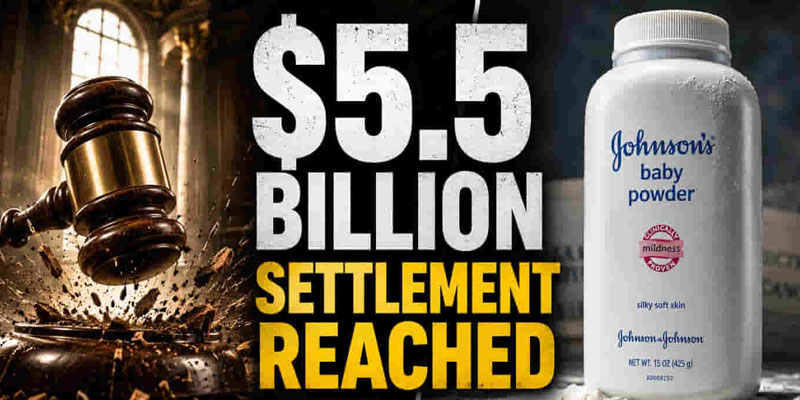
In a significant move to end one of the longest-running product liability battles in U.S. corporate history, Johnson & Johnson (J&J) has proposed a $5.5 billion settlement to resolve approximately 76,000 lawsuits alleging that its talc-based baby powder caused ovarian cancer. The proposed agreement, which covers nearly all remaining ovarian cancer claims pending in U.S. federal and state courts, is contingent upon approval by at least 95% of eligible claimants. The supermajority requirement makes the proposal far more comprehensive than a conventional legal settlement and reflects the company's latest effort to bring finality to years of costly litigation.
A Decade-Long Legal Battle
The litigation against Johnson & Johnson has continued for more than a decade and centres on allegations that its talc-based baby powder and related products were contaminated with asbestos, exposing consumers to an increased risk of ovarian cancer.
Thousands of plaintiffs have claimed that the company was aware of potential health risks but failed to adequately warn consumers. Johnson & Johnson has consistently rejected these allegations, maintaining that its talc products are safe, asbestos-free and do not cause cancer.
Over the years, the company attempted to resolve the litigation through bankruptcy-related restructuring strategies and subsidiary settlement mechanisms. However, multiple courts rejected those efforts, leaving J&J vulnerable to continuing lawsuits, costly jury trials and substantial damage awards.
Why This Settlement Is Different
Unlike previous attempts, the latest proposal directly targets the remaining ovarian cancer claims rather than routing them through bankruptcy proceedings. According to the company, the settlement follows a favourable ruling in the multidistrict litigation (MDL) concerning "specific causation," which it believes has strengthened its legal position.
Instead of continuing years of uncertain courtroom battles, J&J appears to have concluded that a negotiated settlement offers a more predictable and efficient resolution. Beyond limiting financial exposure, the company is also seeking to remove the reputational burden associated with prolonged litigation that has overshadowed one of its most recognised consumer brands.
Settlement Structure and Financial Roadmap
The proposed settlement commits up to $5.5 billion, with payments spread over several years. Reports indicate that the first instalment, capped at $3 billion, would be made in 2027, while no further payments would be required before 2028.
This staggered payment structure enables the healthcare giant to absorb the financial impact without placing excessive pressure on its balance sheet. Importantly, the agreement applies only to existing ovarian cancer claims and does not automatically resolve any future lawsuits or unrelated talc litigation.
Latest Developments and What Lies Ahead
Johnson & Johnson has described the proposed agreement as an "efficient conclusion" to approximately 76,000 ovarian cancer claims, representing nearly 99.75% of the remaining talc-related lawsuits. Despite offering billions of dollars in compensation, the company continues to insist that the allegations are without merit and that its products are scientifically safe.
However, the settlement will become effective only if the required 95% claimant approval is achieved. Failure to reach that threshold could reopen the possibility of prolonged litigation or force both sides back to the negotiating table. Legal observers are also watching whether this agreement eventually becomes a model for resolving the smaller number of future or non-ovarian talc claims.
A Defining Chapter in Corporate Liability
Johnson & Johnson's proposed settlement represents more than a financial payout—it is an attempt to draw a definitive line under one of the largest product liability controversies in modern corporate history. If approved by the required supermajority of claimants, the agreement could finally provide certainty for both the company and thousands of plaintiffs while setting an important precedent for resolving complex mass-tort litigation. Regardless of the outcome, the case will remain a landmark example of how prolonged legal disputes can reshape corporate strategy, public trust and product liability jurisprudence.
(With agency inputs)