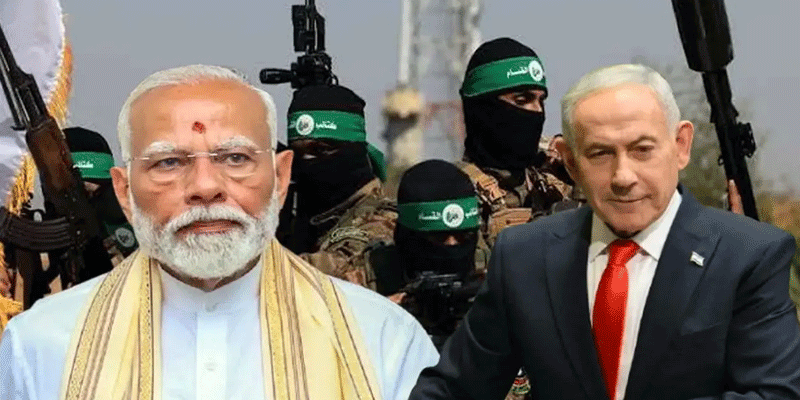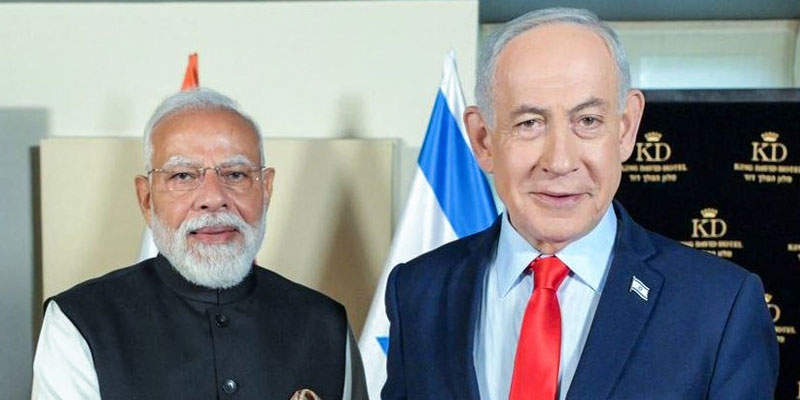
Prime Minister Narendra Modi held wide-ranging talks with Israeli Prime Minister Benjamin Netanyahu, marking a pivotal moment in India–Israel relations. The visit culminated in the elevation of bilateral ties to a “special strategic partnership,” reflecting deepening convergence across security, technology and trade.
Key Agreements: UPI Goes Global, FTA Gains Momentum
Among the standout announcements was an agreement enabling the . The move is expected to streamline digital transactions for Indian tourists, businesses and the Indian diaspora, while expanding India’s fintech footprint abroad. The rollout positions UPI not merely as a domestic payments innovation, but as a global digital public infrastructure export.
PM Modi also confirmed progress toward a comprehensive trade pact, stating, “We will soon give final shape to a mutually beneficial Free Trade Agreement.” An FTA would target enhanced market access in goods, services and investments, potentially unlocking billions in additional trade. Bilateral trade already exceeds $10 billion annually, with Israeli high-tech exports forming a substantial component. A structured agreement could rebalance flows while opening new sectors such as pharmaceuticals, gems and jewellery, agri-tech and digital services.
Diplomatic Engagements and Regional Agenda
Beyond economic agreements, discussions spanned defence, counterterrorism, agriculture, water management and emerging technologies. Modi and Netanyahu reaffirmed their countries’ shared stance against terrorism, with India backing peace efforts in Gaza while maintaining that there is “no place for terrorism.”
The leaders also reviewed progress on the India-Middle East-Europe Economic Corridor (IMEC), envisioned as a strategic trade and infrastructure corridor linking India to Europe via the Middle East. The initiative serves as a counterweight to China’s Belt and Road Initiative and aligns with India’s westward connectivity ambitions.
Cooperation under the I2U2 Group—comprising India, Israel, the UAE and the US—was another focal point. Projects in food security, clean energy and logistics aim to leverage complementary strengths across the four nations.
Earlier, Modi met Israeli President Isaac Herzog, with discussions covering education, startups, innovation ecosystems and connectivity—pillars that underpin the technology-driven partnership.
Strategic Foundations: Defence, Technology and Innovation
India and Israel have steadily built a robust strategic relationship over the past decade. Defence trade alone exceeds $3 billion, encompassing missile systems such as Barak-8, drones and advanced surveillance technologies. Collaboration extends to cyber security, artificial intelligence, precision agriculture and drip irrigation—areas critical to India’s development priorities.
Israel’s technology prowess complements India’s manufacturing ambitions under production-linked incentive (PLI) schemes, while India offers a vast market and talent pool for Israeli innovation. The synergy is not merely commercial but strategic, given shared security concerns and regional volatility.
Geopolitical and Economic Implications
UPI’s entry into Israel—following similar expansions in other partner countries—strengthens India’s push to internationalise its digital payment architecture and reduce dependence on traditional dollar-dominated systems. Meanwhile, the urgency around the FTA reflects both countries’ desire to diversify trade amid global supply chain disruptions.
At a geopolitical level, the upgraded partnership underscores India’s balancing act: deepening ties with Israel while maintaining strong relations with Arab partners. By anchoring cooperation in technology, trade and infrastructure, New Delhi positions itself as a stabilising bridge in a turbulent region.
A Partnership Shaped for a New Era
Modi’s visit signals a maturation of India–Israel ties—from transactional cooperation to a multidimensional strategic alliance. With UPI integration, an impending FTA and renewed connectivity initiatives, the relationship is poised to expand beyond defence into digital, economic and geopolitical domains. In a shifting global order, this partnership reflects India’s ambition to blend economic pragmatism with strategic autonomy—while reinforcing its role as an emerging global power.
(With agency inputs)