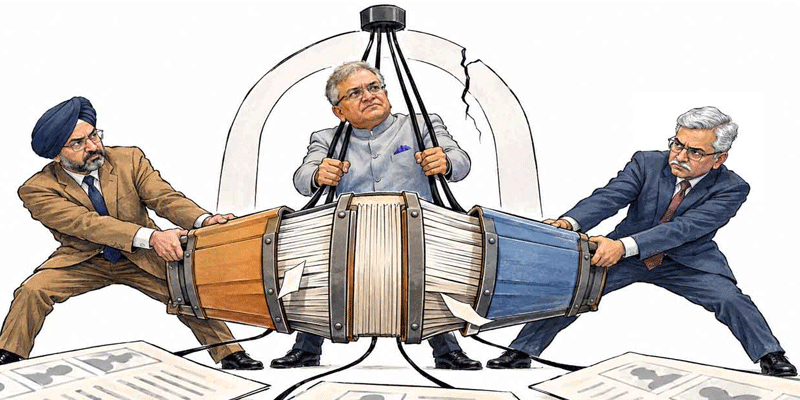
Major General Dr Dilawar Singh
New Delhi:The Strategic Unraveling: Greenland at the Heart of a New Atlantic Rift
In the opening weeks of 2026, a geopolitical crisis of unusual ferocity one intertwining territorial sovereignty, alliance cohesion, and economic diplomacy has thrust Greenland into the center of global attention. Once a remote Arctic outpost, Greenland has become the fulcrum of a confrontation between the United States under President Donald Trump and a cohesive European response that spans the EU, NATO partners, and Arctic states. At issue are not only the future of Greenland, the viability of NATO solidarity, and the contours of transatlantic economic ties, but also the broader resilience of an international order predicated on the rule of law and collective security.
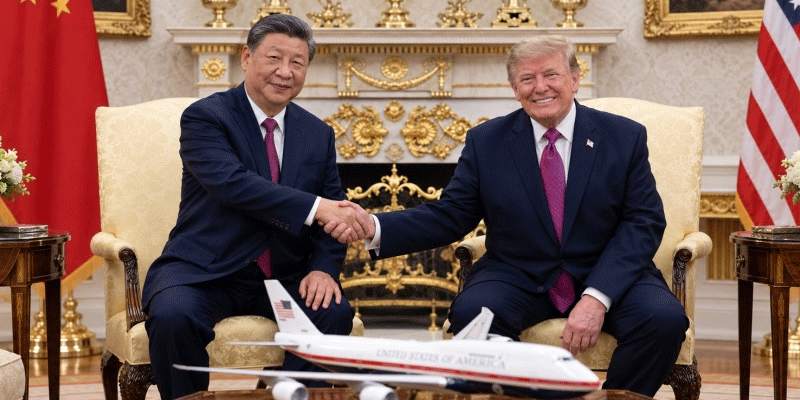
President Trump has escalated his long-standing interest in acquiring Greenland into a full-blown diplomatic and economic ultimatum, threatening to impose tariffs on key European and Nordic allies beginning at 10 % from 1 February 2026 and rising to 25 % in June unless a so-called “deal” for Greenland’s purchase is reached. This tariff gambit targets Denmark, Norway, Sweden, France, Germany, the United Kingdom, the Netherlands and Finland, all of whom have publicly reaffirmed their support for Greenland’s sovereignty as part of the Kingdom of Denmark.
The choice of Greenland is no accident. The vast Arctic territory with its emerging maritime corridors, critical mineral potential, and strategic location for space and missile defense symbolizes both climate-accelerated geostrategy and the recalibration of global power competition. Yet the means by which this strategic objective is being pursued economic coercion against allies and the hint of military leverage has jolted European capitals and NATO institutions alike.
The European Rebuttal: Unity in the Face of Blackmail
Europe’s response to the U.S. tariff threats and the broader coercive posture has been unusually unified and unequivocal. Across the continent, leaders have framed the tariff ultimatum not as a narrow commercial policy adjustment but as an existential challenge to the transatlantic alliance and the fundamental principles of sovereign decision-making.
European Commission President Ursula von der Leyen, speaking at the World Economic Forum in Davos, condemned the tariff threat as a strategic error that could undermine decades of cooperation, particularly following the EU–U.S. trade framework reached only months earlier. She announced plans for a comprehensive Arctic security package and increased European investment in Greenland’s infrastructure, signaling that Europe would not merely defend existing arrangements but deepen its strategic footprint in the Arctic.
National leaders have echoed this stance. French President Emmanuel Macron and British Prime Minister Keir Starmer both characterized tariff threats and overt coercion as unacceptable tactics between allies, with Macron drawing implicit parallels to coercive strategies seen in other theatres of international politics. Likewise, joint NATO partners have warned of a “dangerous downward spiral” if economic intimidation replaces diplomatic dialogue.
What is striking in these responses is not solely the political pushback, but the breadth of solidarity extending from Nordic states to southern Europe, and from EU institutions to NATO capitals. This unity reflects a shared strategic calculus: Greenland’s fate, like that of security in the Arctic, must be determined through consensus, respect for territorial sovereignty, and cooperative defense architectures not through unilateral economic leverage.
NATO Under Strain: Alliance Coherence in the Spotlight
The Greenland crisis lays bare a deeper strain within NATO: the challenge of reconciling the alliance’s collective defense commitments with divergent national and supranational interests. Historically, NATO has been a stabilizing framework preventing conflict among Western states and deterring adversaries. Yet the current confrontation places NATO members on opposite sides of a dispute framed at least by the U.S. president in terms of existential strategic need versus collective alliance decision-making.
The deployment of additional Danish troops to Greenland and rotational contributions from European NATO members have been portrayed by allied capitals as efforts to strengthen Arctic security, not as an antagonistic posture toward Washington. Still, the optics and Trump’s rhetoric linking these deployments to his tariff and acquisition strategy risk eroding the trust that underpins the alliance’s political cohesion.
Russia’s commentary on the situation, suggesting a “deep crisis” within NATO and questioning Denmark’s historical claims, further underscores the geopolitical reverberations of the dispute. Whether intended or not, this escalation feeds into rival narratives that an embattled alliance is susceptible to external pressures and internal fragmentation.
The Legal and Institutional Architecture: Power, Precedent, and the Rule of Law
Beyond the immediate diplomacy and alliance politics, the Greenland crisis raises fundamental questions about the distribution of authority in democratic systems, especially concerning trade and national security powers. In the United States, the legal basis for imposing tariffs unilaterally particularly on allies is itself under judicial scrutiny, with pending court decisions on presidential emergency trade powers that could reshape executive authority. This legal uncertainty introduces a layer of constitutional stakes into an already fraught strategic environment.
Europe’s recourse to instruments such as the Anti-Coercion Instrument (the so-called “trade bazooka”) reveals a parallel dynamic: states and supranational entities are now institutionalizing mechanisms to defend against economic coercion by powerful actors. Whether these mechanisms are deployed, and to what extent they are calibrated to avoid full-scale trade retaliation, will shape future norms around economic statecraft and sovereign rights.
Economic Spillovers and Global Consequences
From the markets to multinational supply flows, the Greenland tariff threat has already introduced volatility. Credit-rating agencies have noted that geopolitical risk premiums are rising across Europe, with implications for growth, trade flows, and financial stability. A 10 % tariff rising to 25 % would not be a mere symbol; it would materially affect trade balances and could reverberate through global supply chains, influencing inflation, investment decisions, and currency valuation.
Furthermore, the crisis has collateral effects beyond the transatlantic sphere: Asian markets are responding to heightened risk sentiment, while emerging and Global South economies are recalibrating their expectations for trade negotiations with both the U.S. and Europe in an environment of strategic unpredictability.
Greenland’s Agency and the Future of Arctic Governance
Amid the great-power positioning, the voices and aspirations of Greenland’s own people deserve central attention. Greenlanders have repeatedly asserted that any decision about their future should be determined by them and Denmark, not by external powers seeking leverage. Europe’s reaffirmation of this principle not merely as rhetoric but as a foundation for integrated security and economic cooperation signals an important normative stance that Arctic governance must prioritize indigenous agency and sovereign choice.
A Strategic Inflection, Not a Passing Storm
The crisis over Greenland transcends the immediate dispute; it represents a strategic inflection point. The world is witnessing a contest not only over territory and strategic advantage in the Arctic but over the very norms that will govern international relations in the twenty-first century: the balance between alliance solidarity and national imperatives, the legitimacy of economic coercion as a tool of statecraft, and the resilience of collective defense architectures in the face of internal discord.
The transatlantic alliance historically a central pillar of stability is being stress-tested in real time. How NATO, the EU, and the United States navigate this moment will either reinforce the foundations of cooperative security or expose fault lines that adversaries could exploit.
In a world of shifting power dynamics, Greenland should not become the site where the principles of alliance and the rule of law are sacrificed at the altar of unilateral ambition. The path forward demands diplomacy rooted in mutual respect, strategic patience, and a commitment to norms that have sustained peace and prosperity for decades.
Breaking News