The United States has deployed military aircraft to Greenland at a moment of heightened geopolitical friction, underscoring how the Arctic is becoming a frontline of great-power competition. While Washington describes the move as routine defense cooperation, the timing—amid renewed political pressure from the White House over Greenland’s future—has amplified unease across Europe and within the NATO alliance.
Routine Deployment, Unusual Context
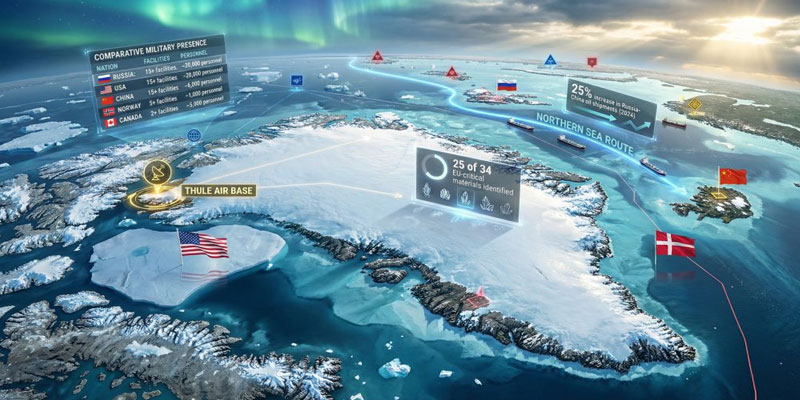
U.S. aircraft have arrived at Pituffik Space Base in northern Greenland, a long-standing American installation critical to missile warning and space surveillance. Officially, the deployment is part of pre-planned North American defense activities coordinated with Denmark and Canada. Yet it unfolds against the backdrop of President Donald Trump’s revived interest in acquiring Greenland, a stance that has reignited sovereignty disputes and injected political tension into what would otherwise be standard military operations. The result is a deployment that carries symbolic weight far beyond its operational scope.
Why Greenland Matters
Greenland’s importance lies in geography and resources. Sitting astride emerging Arctic Sea lanes and close to Russia’s northern flank, it is pivotal for early-warning systems and transpolar defense. Beneath its ice are rare earth minerals and potential energy reserves, attracting long-term interest from both Western states and China. The United States already maintains a modest but critical presence at Pituffik under a 1951 defense agreement with Denmark, which retains sovereignty over the semi-autonomous territory. Trump’s renewed rhetoric—linking Greenland to missile defense needs and competition with Russia and China—has reframed this established arrangement as a contested strategic asset.
Greenlandic Voices: Security Needs Versus Sovereignty
Greenlandic leaders have responded with a careful mix of resistance and pragmatism. Prime Minister Jens-Frederik Nielsen has been among the most vocal critics of any suggestion that Greenland could be acquired or coerced, leading public demonstrations and reaffirming that Greenland’s future will be decided by Greenlanders themselves. His stance reflects widespread concern that increased foreign military activity could erode political autonomy or inflame independence debates.
At the same time, senior figures such as Deputy Prime Minister Mute Egede have acknowledged that a greater NATO presence—including flights, exercises, and patrols—may be unavoidable given Arctic security trends. From this perspective, allied deployments are tolerated as defensive measures, provided they are transparent, coordinated, and respectful of local authority. Greenland’s leadership has emphasized that the latest U.S. aircraft arrivals were communicated in advance and framed within existing defense agreements, not as a unilateral escalation.
NATO Under Strain: Alliance Politics in the Arctic
The deployment’s wider impact is being felt inside NATO. Denmark and other European allies view Greenland as unequivocally covered by NATO’s collective defense clause, meaning any attempt to change its status by force would trigger a profound alliance crisis. Trump’s parallel threats of tariffs against Denmark and several European partners have further blurred the line between economic pressure and security policy, unsettling allies already focused on the war in Ukraine and Russian assertiveness.
This episode exposes a deeper dilemma for NATO: how to maintain cohesion when its leading power appears willing to challenge the sovereignty of another member state. Even without direct confrontation, such tensions risk weakening trust, complicating joint decision-making, and encouraging European allies to hedge by strengthening independent defense capabilities.
A Test Case for Arctic Governance
The U.S. aircraft deployment to Greenland is modest in military terms but significant politically. It highlights how strategic competition, nationalist rhetoric, and climate-driven Arctic change are colliding in ways that strain long-standing alliances. For Greenland, the challenge is balancing genuine security needs with the protection of sovereignty and self-determination. For NATO, the stakes are even higher: preserving unity and credibility in an era when threats may come not only from outside the alliance, but from unresolved divisions within it.
(With agency inputs)