25 States Sue Trump Over Fresh Trade Tariffs
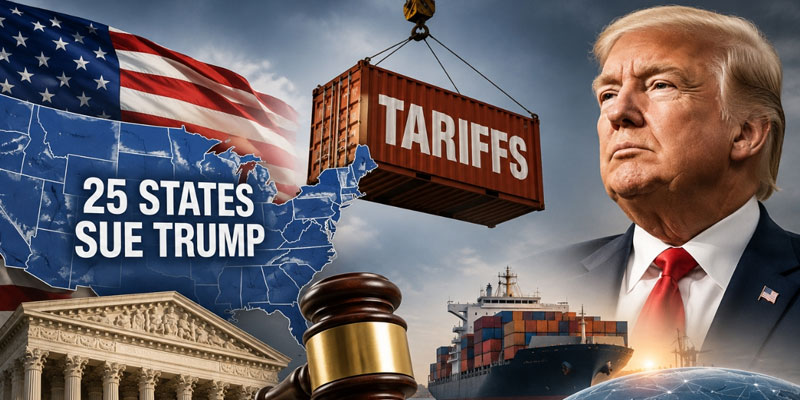
The Donald Trump administration is facing a major legal challenge after a coalition of 25 US states sued the federal government over newly imposed tariffs on imports from 60 trading partners, including India. The states argue that the new levies are merely a pretext to revive a tariff regime that was struck down earlier this year by the US Supreme Court. The lawsuit has transformed what began as a trade policy decision into a broader constitutional debate over the limits of presidential authority in imposing import duties without explicit approval from Congress.
From Supreme Court Defeat to New Tariffs
The latest tariffs, ranging between 10% and 12.5%, came into effect on July 24. India is among the countries subject to the lower 10% tariff, while several other trading partners face duties of up to 12.5%. According to the Office of the US Trade Representative (USTR), the measures affect nearly 99.4% of all US imports, making them one of the broadest trade actions in recent years.
The Trump administration has defended the move by invoking Section 301 of the Trade Act of 1974, arguing that the targeted countries have failed to adequately restrict imports linked to forced labour. Under the new framework, nations with stronger forced-labour import restrictions receive the lower tariff rate, while others face higher duties.
The decision comes just months after the US Supreme Court, in a 6-3 ruling in February, held that the International Emergency Economic Powers Act (IEEPA) could not be used to impose sweeping global tariffs. The Court ruled that such extensive taxation of imports requires clear congressional authorization, dealing a significant setback to the administration's earlier tariff strategy.
States Mount a Constitutional Challenge
Led by Democratic attorneys general, the coalition—including New York, California, Illinois, Massachusetts, Michigan, New Jersey, Pennsylvania, Washington and several other states—has filed its petition before the US Court of International Trade.
The states contend that the administration is attempting to circumvent the Supreme Court's ruling by using the forced-labour rationale under Section 301 to effectively recreate the same tariff structure. They argue that Section 301 was never intended to justify sweeping country-wide tariffs without demonstrating a direct connection between a specific unfair trade practice and the duties imposed.
Economic Stakes for the US and Global Trade
The plaintiffs warn that the tariffs will increase costs for American consumers, manufacturers and state governments by making imported goods, industrial components and machinery more expensive. Businesses dependent on global supply chains may face higher production costs, potentially leading to price increases across multiple sectors.
For countries like India, the tariffs could affect exports of textiles, engineering products, pharmaceuticals and other price-sensitive goods, depending on product-specific exemptions and future trade negotiations. Meanwhile, importers may postpone contracts or diversify sourcing until the legal uncertainty is resolved.
A Landmark Battle Over Executive Power
Beyond trade, the lawsuit represents a defining test of constitutional governance in the United States. The central issue is no longer just tariffs but whether the executive branch can rely on expansive interpretations of existing laws to pursue a long-term trade agenda after the Supreme Court has rejected its earlier legal basis. The outcome will not only shape America's future trade policy but also determine the balance of power between the President and Congress in regulating international commerce.
(With agency inputs)