India’s MSMEs are powering the next wave of entrepreneurship with remarkable resilience, innovation, and inclusivity. Once viewed as small, localized business units, Micro, Small and Medium Enterprises have evolved into the backbone of India’s economic transformation. From rural manufacturing clusters and women-led enterprises to digitally enabled startups in tier-2 and tier-3 towns, MSMEs are reshaping the country’s entrepreneurial narrative while creating opportunities far beyond metropolitan India.
The Rise of India’s MSME Economy
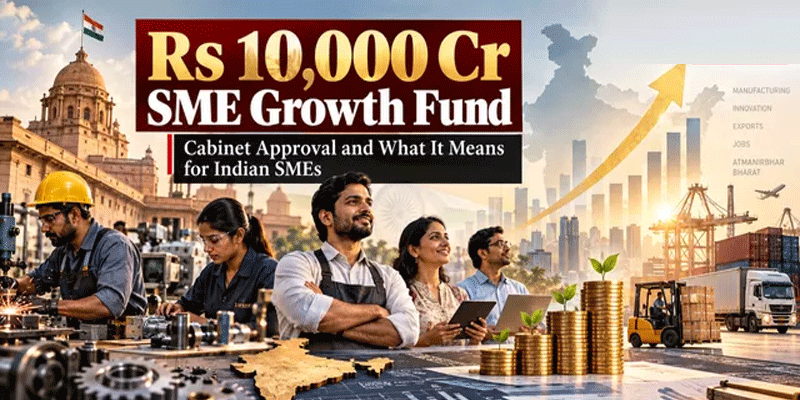
India’s MSME ecosystem today represents one of the largest entrepreneurial networks in the world. As of November 2025, over 7.16 crore MSMEs are registered on the Udyam Portal, collectively employing nearly 31.33 crore people. The sector contributes close to 30% of India’s GDP and over 45% of total exports, underlining its strategic importance to the national economy.
The journey of Indian MSMEs reflects the broader evolution of India’s economic ambitions. Traditionally dominated by small family-run businesses, artisans, and local manufacturers, the sector has steadily transitioned into a dynamic growth engine supported by digital infrastructure, policy reforms, and improved market access. Today, micro enterprises account for nearly 95% of the sector, while small and medium enterprises continue expanding their footprint across manufacturing, services, retail, logistics, and exports.
The government’s policy push has accelerated this momentum. The FY26 Union Budget allocated Rs. 23,168 crores to the MSME Ministry, marking a 4.6% increase over FY25. Revised investment thresholds now allow micro enterprises to invest up to Rs. 2.5 crore, while medium enterprises can invest up to Rs. 125 crores, encouraging scale and competitiveness. Simultaneously, schemes such as PMEGP and Mudra have expanded entrepreneurial access, with over Rs. 33.65 lakh crore sanctioned through 52.37 crore Mudra loans.
Digital Transformation and Inclusive Entrepreneurship
One of the defining shifts in the Indian MSME landscape has been rapid digital adoption after the pandemic. Nearly 95% of MSMEs now use online payment systems, with UPI emerging as a transformative catalyst. Simplified GST filing, digital bookkeeping, e-commerce platforms, and SaaS-based tools have enabled even small-town businesses to formalize operations and access wider consumer markets.
Women entrepreneurs are also redefining the sector’s growth story. Women-owned enterprises now constitute over 38% of registered MSMEs under the RAMP scheme, while nearly 15 million MSMEs are led by women across manufacturing, services, and trade. Their growing participation reflects not only financial empowerment but also deeper social transformation.
Equally significant is the modernization of rural and traditional industries. Handicrafts, textiles, and food processing businesses are increasingly leveraging AI tools, digital commerce, and cold-chain logistics to compete nationally and globally. Despite disruptions such as demonetization, GST implementation, and the pandemic, Indian MSMEs have demonstrated extraordinary adaptability.
Recognizing the New Entrepreneurial India
Initiatives such as Tally MSME Honours 2026 further spotlight this entrepreneurial momentum by celebrating emerging business leaders across categories including women-led ventures, technology transformation, and digital entrepreneurship. Such platforms reinforce the growing recognition that India’s future growth story will be written not only in large cities, but also in small towns and rural markets.
The Real Architects of India’s Growth
India’s MSMEs are no longer peripheral contributors to economic growth; they are central architects of the country’s future. Their expanding market value, digital readiness, and entrepreneurial diversity are redefining India’s economic landscape. As fintech innovation, AI adoption, and digital infrastructure continue to strengthen the ecosystem, MSMEs are poised to become the driving force behind a more inclusive, globally competitive, and self-reliant India.
(With agency inputs)