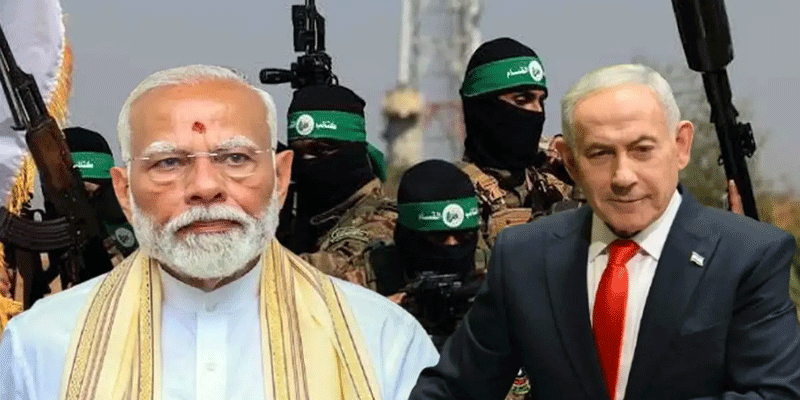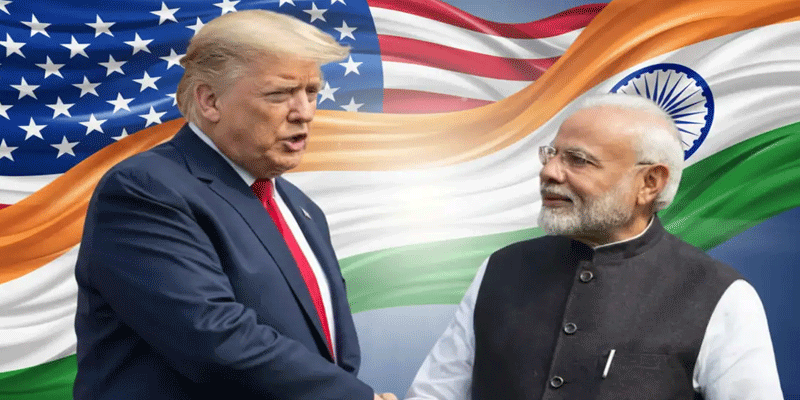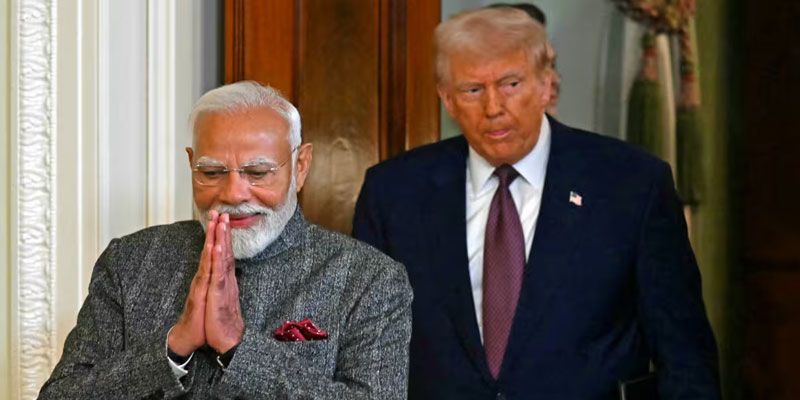
President Donald Trump once again described Prime Minister Narendra Modi as a “fantastic leader” and a “close friend,” projecting warmth and personal chemistry on the global stage. Speaking on the sidelines of the World Economic Forum in Davos on January 21, 2026, Trump expressed confidence that the United States and India would ultimately reach a “good deal.” Yet this praise comes against the backdrop of punitive tariffs that continue to weigh heavily on bilateral trade, revealing a familiar pattern in Trump’s diplomacy: repeated compliments paired with sustained economic pressure.
Repetition, Rapport, and the Return of Tariffs
Trump has praised Modi many times before—at rallies, bilateral meetings, and international forums—and he keeps saying it again. The language rarely changes: strong leader, trusted partner, personal friend. Almost as predictably, trade friction follows close behind. Even as Trump’s rhetoric signals goodwill, the tariff flow continues, shaping the real economic relationship. This duality underscores how personal diplomacy and coercive economics coexist in Washington’s approach to New Delhi.
How Tariffs Became the Central Lever
The current strain dates back to August 2025, when the U.S. imposed a cumulative 50% tariff on Indian exports—split between a standard 25% duty and an additional 25% “penalty” tied to India’s continued purchases of Russian crude oil. Framed as a national security measure in the context of the Ukraine war, the decision sharply disrupted trade flows.
The impact was immediate. Indian exports to the U.S.—its single largest market—fell by over 20% in late 2025, with some months seeing steeper declines. While India avoided overt retaliation, it quietly raised duties on select U.S. agricultural imports such as lentils, signalling resistance without escalation. The episode demonstrated how tariffs, rather than formal sanctions, have become Trump’s preferred instrument of pressure.
State of U.S.–India Trade Talks
Officially, both sides remain committed to an ambitious goal of doubling bilateral trade to $500 billion by 2030. In practice, negotiations have stalled over familiar fault lines: agricultural market access, digital trade rules, and regulatory barriers. U.S. officials argue that tariffs have already nudged India to reconsider aspects of its energy sourcing. New Delhi, however, maintains that Russian oil purchases are market-driven and essential for domestic energy security.
Despite these disagreements, channels remain open. Diplomats on both sides insist talks are ongoing, though progress has been incremental rather than transformative.
The “Praise and Punish” Playbook in Action
Trump’s Davos remarks fit squarely within his established negotiating style. Flattery is used to sustain personal rapport, while economic penalties are deployed to extract concessions. The strategic objectives are clear: reduce India’s dependence on Russia, open Indian markets to U.S. farmers and technology firms, and lock India more firmly into Washington’s broader Indo-Pacific strategy, including counterbalancing China.
Critics note the contradiction in celebrating friendship while imposing costs that ultimately ripple through American importers and consumers as well. Supporters counter that tariffs generate leverage and revenue, forcing partners to engage seriously.
Economic and Strategic Consequences
For India, the tariffs have pressured exporters, especially small and medium firms, while shaving a modest but tangible fraction off GDP growth. Supply chains have adjusted through diversification, rerouting, and cost absorption, but prolonged uncertainty risks longer-term competitiveness. Strategically, New Delhi must balance its expanding partnership with Washington against its energy ties with Russia and commitments within BRICS and other multilateral groupings.
Warm Words, Hard Choices
Trump’s repeated praise of Modi reinforces the personal dimension of U.S.–India ties, but it does not soften the structural realities of trade conflict. The coexistence of admiration and tariffs is not accidental; it is central to Trump’s negotiating philosophy. Whether this approach ultimately produces a durable, balanced trade agreement—or deepens mistrust beneath the surface of friendly rhetoric—will depend on whether Davos-style optimism can be converted into concrete compromises on both sides.
(With agency inputs)