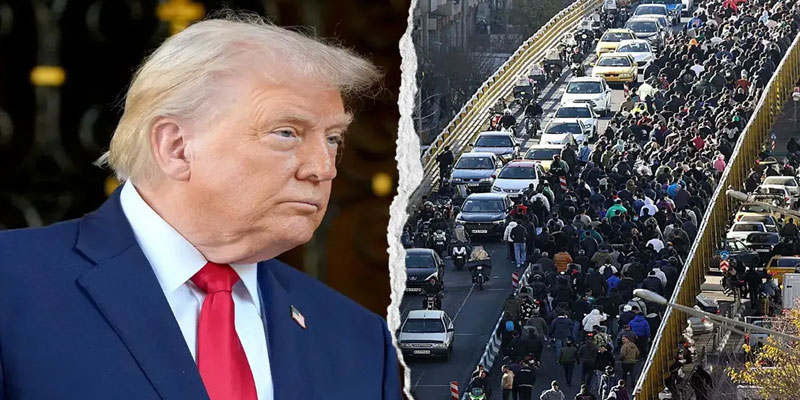
“Big Force” Moving Toward Iran, US Says It Is Watching Closely
President Donald Trump has confirmed that a substantial US military deployment is moving toward the Persian Gulf, signaling renewed pressure on Iran amid its violent suppression of nationwide protests. Speaking aboard Air Force One after the Davos summit on January 22, 2026, Trump said a “big force” was heading toward Iran but emphasized that Washington was not seeking immediate conflict. The message was clear: deterrence first, escalation only if Tehran crosses red lines.
The Crisis Driving the Escalation
Iran has been gripped by its most severe internal unrest in decades. Protests that erupted in late December 2025 over economic collapse—marked by soaring inflation, currency freefall, and unemployment—rapidly evolved into open challenges to the ruling clerical establishment. Security forces responded with sweeping force, deploying live ammunition, mass arrests, and executions. While Iranian authorities acknowledge thousands of deaths, opposition groups claim the toll may be several times higher.
The turning point came when Iran abruptly paused hundreds of scheduled executions last week. Trump publicly credited US pressure for the move, framing it as evidence that firm signaling can influence Tehran’s behavior without immediate military action.
Washington’s Pressure Strategy: Force Without Fire
The deployment, led by the USS Abraham Lincoln carrier strike group and supported by aircraft, missile defenses, and regional air assets, reflects what US officials describe as “coercive deterrence.” Assets redeployed from Asia underscore the seriousness of the message. At the same time, the White House has avoided framing the build-up as a prelude to strikes, instead presenting it as leverage to shape Iranian decisions.
This approach fits Trump’s broader foreign policy pattern: apply visible pressure, keep diplomatic doors ajar, and push adversaries toward negotiations rather than prolonged wars. Treasury sanctions on Iranian officials linked to the crackdown complement the military posture, tightening the vise without triggering open conflict.
The Roles of the US and UAE as Facilitators
The United States is acting as both enforcer and potential negotiator. Militarily, it provides the backbone of deterrence, reassuring Gulf allies and signaling readiness to protect shipping lanes and regional partners. Diplomatically, Washington remains open to indirect talks, using pressure to extract concessions on human rights, nuclear constraints, and regional proxy activity.
The UAE’s role, while less visible, is strategically important. As a trusted interlocutor with working ties to Washington and Tehran, Abu Dhabi is positioned to serve as a quiet conduit for de-escalation. Alongside Oman and Qatar, the UAE has previously hosted discreet discussions and could again provide neutral ground for backchannel engagement, helping translate military pressure into diplomatic off-ramps.
Risks of Miscalculation and Regional Fallout
Iran has warned that it is keeping its “finger on the trigger,” raising fears of retaliation through proxy attacks, strikes on US bases, or disruption of shipping through the Strait of Hormuz. Any such move could rapidly escalate tensions, spike global oil prices, and draw in regional actors, including Israel, which remains skeptical of prolonged restraint.
A Narrow Path Between Deterrence and Diplomacy
Trump’s decision to deploy a major force toward Iran is a calculated gamble—designed to curb repression and compel restraint without igniting another Middle Eastern war. Success depends on careful calibration: enough pressure to influence Tehran, but sufficient diplomatic engagement, aided by regional facilitators like the UAE, to prevent miscalculation. As US warships near the Gulf, Iran faces a stark choice between limited accommodation and deeper confrontation, with consequences that will reverberate far beyond its borders.
(With agency inputs)