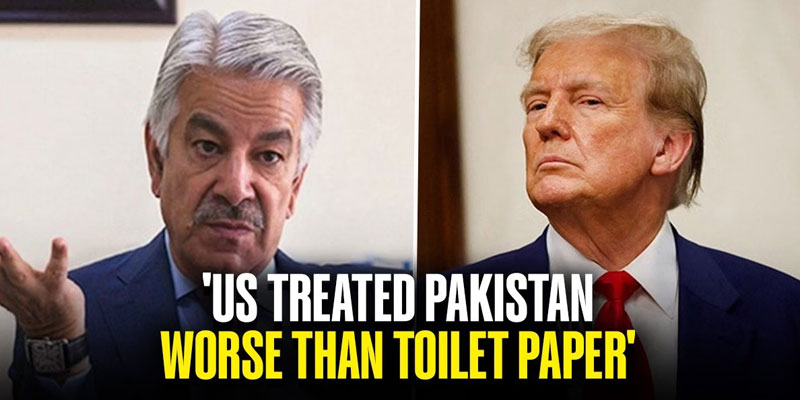
A Stark Admission in Parliament
Pakistan’s Defence Minister Khawaja Asif has delivered one of his sharpest public critiques of Washington, accusing the United States of using Islamabad for strategic purposes and then abandoning it “worse than toilet paper.” The unusually blunt remark, made in parliament, signals deep frustration within Pakistan’s political establishment over the long-term consequences of its alliance with the US during the Afghan conflicts. His statement also reflects a broader reassessment of past security choices and their domestic costs.
Asif’s Remark Signals Pakistan’s Deep Rift with US
For decades, Pakistan positioned itself as a frontline partner in US-led efforts in Afghanistan, first during the Soviet invasion and later in the post-9/11 war on terror. While the partnership brought financial assistance and diplomatic engagement, it also entangled Pakistan in prolonged conflict, internal instability, and economic strain. Asif’s comments highlight a growing narrative within Pakistan that the country bore disproportionate costs while receiving limited long-term benefits.
Historical Context and Strategic Choices
Pakistan’s cooperation with the United States intensified after 2001, when Islamabad provided logistics, intelligence, and operational support for US forces in Afghanistan. In return, it received billions of dollars in military and economic assistance. However, the relationship remained transactional and often tense, marked by disagreements over counterterrorism priorities, drone strikes on Pakistani territory, and accusations from Washington that militant groups continued to operate within Pakistan’s borders.
The US withdrawal from Afghanistan in 2021 further reshaped the dynamic. Pakistan found itself confronting renewed militant threats along its western frontier and navigating an increasingly complex geopolitical environment. Asif’s remarks suggest a recognition within Pakistan’s leadership that earlier strategic alignments may have produced unintended domestic consequences.
Economic Consequences of Supporting the Afghan War
Pakistan’s participation in the US-led campaign carried significant economic repercussions. Official estimates and independent analyses suggest that while Islamabad received tens of billions of dollars in assistance over two decades, the broader economic toll far exceeded those inflows.
Security operations in border regions required substantial public spending on military deployments, infrastructure protection, and rehabilitation of displaced populations. Conflict-related instability discouraged foreign investment, dampened tourism, and disrupted trade routes. Industrial activity in affected areas declined sharply, and many businesses relocated or shut down due to security concerns.
The broader macroeconomic impact included slower GDP growth, rising public debt, and increased inflationary pressures. Export sectors such as textiles faced reduced competitiveness amid instability and global scrutiny. Additionally, the costs of counterterrorism measures and reconstruction strained public finances, contributing to fiscal deficits that persist today.
Political Messaging and Domestic Calculations
Asif’s criticism also carries domestic political resonance. Pakistan continues to grapple with economic challenges, including inflation and debt, making foreign policy narratives politically salient. By acknowledging past missteps and external pressures, leaders may be attempting to recalibrate public perception and assert a more independent strategic posture.
A Turning Point in Strategic Reflection
The defence minister’s candid remarks underscore a broader reassessment of Pakistan’s foreign policy trajectory. While the US-Pakistan partnership delivered short-term strategic gains, its long-term economic and security consequences remain contested. Moving forward, Pakistan faces the task of balancing international partnerships with domestic stability and economic recovery. Whether Asif’s statement marks a lasting policy shift or a moment of political rhetoric, it reflects a country re-examining the costs of past alliances and seeking a more self-defined path.
(With agency inputs)