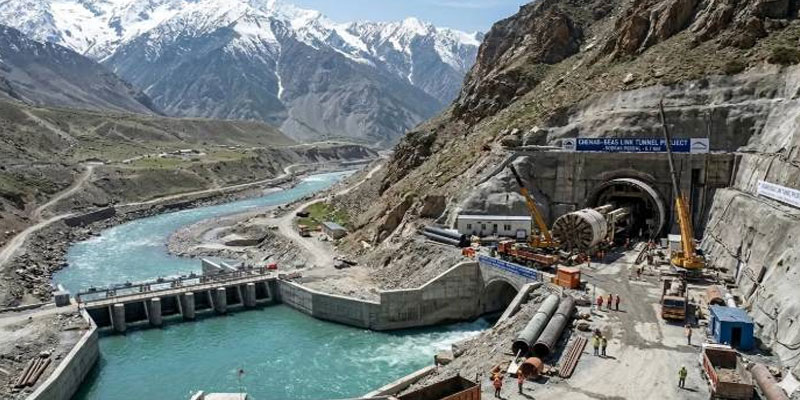
India’s proposed Chenab-Beas Link Tunnel project has emerged as a new flashpoint in India-Pakistan relations, drawing attention because of its connection to the sensitive Indus River system. The project aims to divert surplus water from the upper Chenab basin into the Beas River system to address seasonal shortages in northern India. However, since the Chenab is one of the western rivers governed under the Indus Waters Treaty, the proposal has triggered strong objections from Pakistan, which fears downstream water disruptions and potential treaty violations.
The Chenab-Beas Link Tunnel Project
The proposed project, estimated at ₹2,352 crore, involves the construction of an 8.7-kilometre underground tunnel designed to transfer surplus water from the Chenab basin into the Beas river system. The initiative is intended to improve water availability during summer months in regions dependent on the Beas.
The first phase includes the construction of a 19-metre-high barrage on the Chandra River near Koksar village in Himachal Pradesh’s Lahaul Valley. The Chandra River is a tributary of the upper Chenab basin in the western Himalayas.
The project is expected to facilitate the annual diversion of approximately 1.9-million-acre feet of water. The National Hydroelectric Power Corporation is overseeing the implementation, with work scheduled to begin on August 1, 2026, and targeted for completion by July 2029.
Why Pakistan Has Raised Objections
Pakistan’s concerns stem directly from the framework of the Indus Waters Treaty signed in 1960. Under the agreement, India received exclusive rights over the eastern rivers — Ravi, Beas, and Sutlej — while Pakistan retained primary rights over the western rivers, including the Indus, Jhelum, and Chenab, although India was allowed limited usage under specified conditions.
Islamabad argues that diverting water from the Chenab basin into the Beas system constitutes an inter-basin transfer that could alter downstream river flows. Pakistani officials have described the project as a “grave violation” of the treaty and warned of “dangerous implications” for the country’s water security.
Pakistan has also alleged that the proposal violates broader principles of international water law and the Vienna Convention on the Law of Treaties. Some officials have accused India of attempting to “weaponise” water resources amid already strained bilateral relations.
India’s Strategic and Technical Position
India, however, maintains that the project falls within its permissible rights under the treaty framework. Officials argue that the tunnel primarily seeks to utilise surplus water that would otherwise remain underused while supporting irrigation and water needs in Himachal Pradesh, Punjab, Rajasthan, and Haryana.
Analysts have pointed out that the diversion capacity remains relatively small compared to the Chenab’s total annual yield in India, estimated at over 26-million-acre feet. As a result, experts suggest that the impact on Pakistan may remain limited and largely seasonal rather than fundamentally altering agricultural water availability.
The project is also part of India’s broader strategy to maximise utilisation of its allocated river waters through infrastructure expansion in the Himalayan region.
Water Diplomacy Under Renewed Strain
The Chenab-Beas Link Tunnel highlights how water infrastructure projects continue to shape geopolitical tensions between India and Pakistan. While India views the initiative as a legitimate developmental and strategic effort, Pakistan sees it as a challenge to long-standing treaty arrangements and regional water stability. As construction plans move forward despite diplomatic objections, the project is likely to remain a sensitive issue in South Asia’s already fragile political landscape, underscoring the growing intersection of water security, infrastructure, and regional diplomacy.
(With agency inputs)