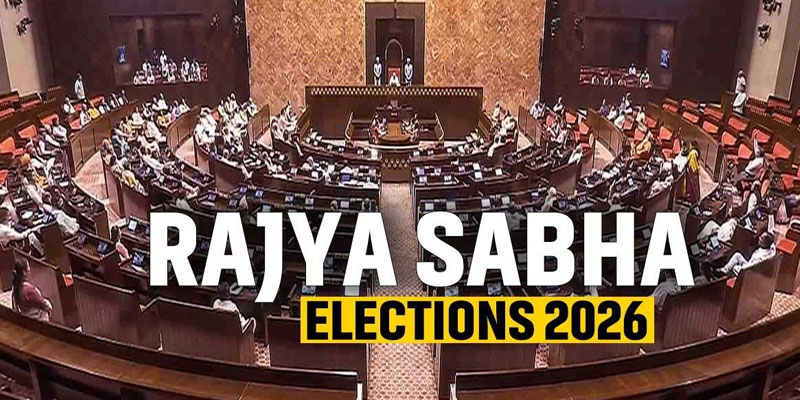
The 2026 elections to the Rajya Sabha—India’s Upper House of Parliament—have emerged as a crucial political contest, not just for seat arithmetic but for testing alliances ahead of future national battles. Polls are being held for 37 seats across 10 states, with several results already decided even before voting began.
Out of these seats, 26 candidates have already been elected unopposed from states including Maharashtra, West Bengal, Tamil Nadu, Telangana, Chhattisgarh, Assam and Himachal Pradesh. Major parties such as the Bharatiya Janata Party (BJP), Indian National Congress, All India Trinamool Congress (TMC) and Dravida Munnetra Kazhagam (DMK) secured several uncontested victories thanks to their legislative strengths in respective states.
Why Three States Became the Opposition’s Loyalty Test
The most intense contests are unfolding in Bihar, Odisha and Haryana. These states have become crucial testing grounds for the opposition’s ability to maintain unity within the broader anti-BJP political front.
In Bihar, five Rajya Sabha seats are at stake. The ruling National Democratic Alliance (NDA) enjoys a comfortable majority in the state assembly, allowing it to secure four seats easily. The fifth seat, however, has become a symbolic contest between the NDA and the opposition bloc led by the Rashtriya Janata Dal (RJD).
The opposition alliance, often referred to as the INDIA bloc, holds around 35 MLAs—short of the number required to win the seat outright. To bridge the gap, the RJD has sought support from smaller parties such as the All India Majlis-e-Ittehadul Muslimeen (AIMIM) and the Bahujan Samaj Party (BSP). The outcome will reveal whether opposition parties can close ranks or whether cross-voting weakens the coalition.
In Odisha, a similar battle is unfolding over the fourth seat. While the Bharatiya Janata Party and Biju Janata Dal (BJD) are expected to secure seats comfortably, the remaining contest pits a BJP-backed independent candidate against a candidate supported jointly by BJD and Congress. The situation has been tense enough for the Congress to reportedly move its MLAs to another state to prevent defections or cross-voting.
Key Candidates and Who Has Already Won
Among the most prominent candidates in the race is Nitish Kumar of the Janata Dal (United). Backed by the NDA’s strong numbers in Bihar, Kumar is widely expected to secure a Rajya Sabha seat comfortably. His candidacy has also sparked speculation about possible changes in Bihar’s political leadership if he transitions fully to national politics.
Another key NDA figure contesting from Bihar is Nitin Nabin of the BJP, while JD(U)’s Ramnath Thakur is also considered secure due to coalition support.
Several high-profile leaders have already entered the Rajya Sabha unopposed. These include veteran politician Sharad Pawar from Maharashtra, senior Congress leader Abhishek Singhvi from Telangana, DMK’s Tiruchi Siva from Tamil Nadu and BJP leader Vinod Tawde.
Their uncontested victories reflect the political arithmetic in state assemblies where ruling alliances hold decisive majorities.
A Numbers Game with National Implications
Although Rajya Sabha elections are technically indirect contests decided by state legislators, the 2026 round carries significance far beyond simple seat counts. For the ruling NDA, expanding its numbers in the Upper House strengthens its ability to pass major legislation and pursue long-term policy goals.
For the opposition, however, the elections are about credibility and cohesion. The battles in Bihar and Odisha, in particular, reveal whether opposition parties can maintain unity under pressure or whether internal divisions will weaken their challenge to the ruling coalition.
Ultimately, these contests highlight how even a handful of seats in the Rajya Sabha can shape the national political landscape—making loyalty, alliances and legislative arithmetic as important as the final vote tally.
(With agency inputs)