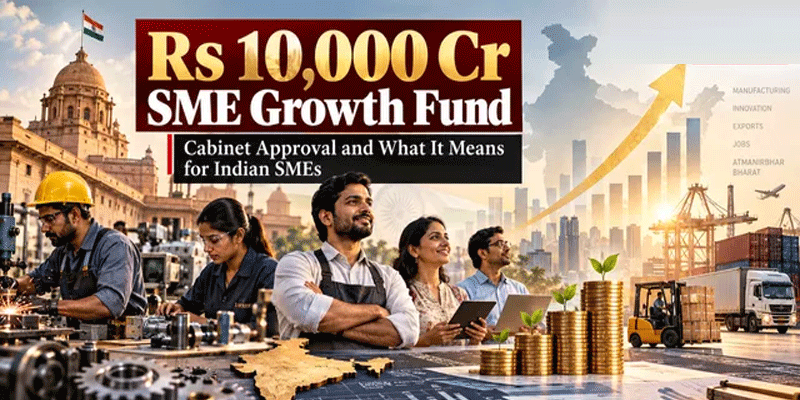
The Union Cabinet’s approval of a ₹10,000-crore SME Growth Fund marks a significant step in strengthening India’s next generation of high-growth enterprises. Announced under the Union Budget 2026-27 framework, the initiative is designed to provide long-term equity capital to promising SMEs and help them scale, modernise, innovate and compete in global markets.
SMEs: The Backbone of India’s Growth
Small and medium enterprises occupy a critical position in India’s economic architecture. According to the Ministry of MSME’s 2025-26 annual report, the broader MSME sector contributes around 31.1% of GDP, 35.4% of manufacturing output and more than 48.5% of exports. It is also a major source of employment and entrepreneurship, particularly because smaller enterprises can generate jobs with relatively lower capital requirements.
Beyond these numbers, SMEs strengthen industrial supply chains by supplying components and services to sectors such as automobiles, defence, engineering and electronics. Their presence across smaller cities and industrial clusters also helps spread economic activity beyond major metropolitan centres.
Why Growth Capital Matters
A major challenge for established SMEs is the shortage of patient growth capital. Bank finance can support working capital, machinery purchases and conventional expansion, but businesses entering a larger growth phase often require equity rather than additional debt.
The ₹10,000-crore fund seeks to address precisely this gap. Structured through an Alternative Investment Fund, it will provide direct, long-term equity support to viable, high-potential enterprises.
The capital can help companies:
· Expand production capacity and enter new markets.
· Adopt automation, advanced machinery and emerging technologies.
· Strengthen research, product development and innovation.
· Undertake strategic acquisitions and business expansion.
· Build globally competitive brands and intellectual property.
· Access international markets and integrate with global value chains.
Manufacturing at the Heart of Expansion
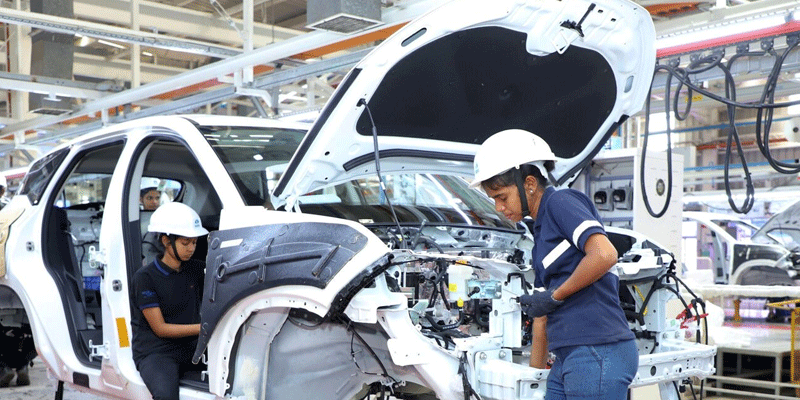
The emphasis on manufacturing could give the initiative an even broader industrial impact. A significant share of the fund is expected to support manufacturing-focused SMEs, including businesses operating in Tier-II and Tier-III industrial clusters.
This could strengthen regional supply chains while encouraging industrial decentralisation. As enterprises expand in smaller cities, they can generate demand for logistics, transport, maintenance, skilled labour, financial services and other local businesses.
The approach also supports India’s larger objectives of increasing domestic value addition, reducing import dependence and positioning Indian enterprises within global manufacturing networks.
From Finance to Industrial Transformation
The SME Growth Fund should therefore be viewed as more than another financing programme. Equity capital can give promising businesses the financial flexibility to take calculated risks without the immediate repayment burden associated with conventional borrowing.
However, capital alone cannot guarantee transformation. Its effectiveness will depend on transparent selection, professional fund management and timely deployment. The initiative should also be complemented by better infrastructure, technology centres, skill development, export facilitation, public procurement opportunities and stronger mechanisms for resolving delayed payments.
Building India’s Next Economic Champions
The ₹10,000-crore SME Growth Fund has the potential to create a stronger pipeline of Indian companies capable of moving from regional success to national and global competitiveness. If finance is combined with technology, skills, market access and institutional support, promising SMEs can evolve into large-scale employers, exporters and innovators.
The real measure of the fund will not be the capital it deploys, but the globally competitive Indian companies it helps create.
(With agency inputs)